


Prevention in Practice: Insights from Action Learning
Please find a PDF version of the report here: Prevention in Practice: Insights from Action Learning
Acknowledgements
Our thanks go to all our Action Learning Set participants, as well as the two local authorities that hosted this work during 2025. These local authorities took part in a competitive process in January 2025 and were selected because they demonstrated a robust and open commitment to learning and to the collaborative working needed to improve key socio-economic determinants of health and support a shift towards prevention. Their commitment to openness, scrutiny and constructive engagement has enabled the insights reported here. We believe these insights help demonstrate what needs to happen to support further work on Scotland’s persistent health inequalities, including the importance of addressing the implementation gap between our collective ambitions and what happens in practice.
All of the Action Learning Set participants gave their time generously and engaged openly, bringing professional insight, lived experience and thoughtful challenge to complex and often difficult discussions about tackling health inequalities and driving upstream prevention in Scotland. Their willingness to reflect honestly on practice, tensions, unintended consequences and opportunities for change has been central to the learning presented in this report. Every contribution was valued and critical to this work.
We also thank Community Renewal Trust, particularly John Halliday and Fran Armour, for their commitment to this work and for their facilitation, note-taking and analysis. We are grateful, too, to colleagues across North Lanarkshire and the City of Edinburgh, and to their partner organisations, whose wider engagement made this work possible. We offer particular thanks to Andrew McPherson, former Deputy Chief Executive of North Lanarkshire Council; Stephen Llewellyn, Deputy Chief Executive of North Lanarkshire Council and formerly Chief Officer for Housing; Alison Gordon, Chief Social Work Officer for Education, Families, Justice and Integrated Practice at North Lanarkshire Council; Kerri Todd, Head of Health Improvement at NHS Lanarkshire; Paul Kane, Business Manager for Employability and Skills Development at North Lanarkshire Council; Margaret Kelly, Business Strategy Manager for Housing at North Lanarkshire Council; and Brian Smedley, Education and Families Manager for Justice Social Work at North Lanarkshire Council.
We also would like to thank the following in Edinburgh: Derek McGowan, Service Director, Housing and Homelessness at Edinburgh City Council , Flora Ogilvie , Consultant in Public Health : Edinburgh Population Health, Public Health and Health Policy, NHS Lothian, Amy Hutton , Director of Services, Cyrenians, Kate Kelman, Depute Chief Executive Officer, Capital City Partnership, Gillie Severin, Head of Strategy, Chief Executives Office at Edinburgh City Council.
The authors gratefully acknowledge colleagues at SHERU, especially Ian Macartney for his hard work on the report design and Christy McFadyen for her support with coding and analysis, and our wider colleagues Dr Spencer Thompson, David Jack, Allison Catalano, Mairi Spowage, Dr Lisa Garnham and Emma Congreve for ideas and discussions along the way. This work was only possible due to funding from the Health Foundation. We would also like to express specific thanks to Chris Creegan and David Finch, of the Health Foundation, for their valuable support and contributions to this work.
Disclaimer: The views, opinions, and conclusions expressed in this report are those of the authors and do not necessarily reflect the official position, policies, or views of the affiliated institution, organisation, funder, or any associated parties. Any errors or omissions remain the responsibility of the authors.
Executive Summary
Meeting Scotland’s Ambitions
The Scottish Government’s new five-year Programme for Government, Ambitious for Scotland [1], sets out a new direction for delivery. It builds on longstanding commitments to prevention and early intervention, person-centred support and collaboration across organisational boundaries. Given the scale and persistence of health inequalities in Scotland, such ambition is clearly needed. Scotland has, however, been committed to prevention for at least 15 years. There is now a pressing need to understand how these ambitions can be realised in practice, at a time when many public services are under growing pressure. This means working better to understand why until now there has been such a gap between policy intent and lived realities in order to find concrete ways to strengthen policy design and implementation. This report asks: What does prevention look like from the perspective of the people trying totrying to implement Scotland’s major social policies?
Building on SHERU’s wider programme examining housing and employability as key building blocks of health, we brought together practitioners, managers and leaders from housing, health, employability, justice, local government and the third sector across City of Edinburgh and North Lanarkshire. Through six Action Learning Sets, a change methodology, participants shared their insights into how they work to translate national ambitions into everyday practice, where efforts to take more preventative approaches succeed or struggle, and what this means for Scotland’s efforts to reduce health inequalities.
This work is not an evaluation of organisations, policy areas or initiatives. Rather, it provides a ‘metaphorical mirror’ through which participants reflected collectively on the realities of implementing policies that aim to improve housing, employment and wellbeing through a preventative approach, within a context of high and complex service demand. The findings highlight the valuable implementation intelligence held within local systems. Much of this knowledge is dispersed across services, organisations and professional roles and is rarely brought together through national policy analysis, routine performance reporting or outcome-focused evaluations.
What we found
Across two local authority areas and three Action Learning Set topics (preventing homelessness, employability and supporting young adult men), participants described remarkably similar implementation challenges. They strongly and consistently supported Scotland’s preventative ambitions. This is an important finding, since it suggests the challenge is not about persuading frontline services that prevention and early intervention are worthwhile. The difficulties participants described were not about the overarching policy direction – they were about the conditions in which strategies are being implemented. Participants felt that national policy does not always recognise, reflect or respond to these realities. These challenges were being experienced against a backdrop of dense, intersecting policies and broader patterns of rising demands in the past decade.
Six recurring implementation questions emerged:
1. Why does prevention remain so difficult when everyone agrees it matters?
Participants described systems responding to rising demand, housing shortages, workforce pressures and increasingly complex needs within communities. The result was that, despite valuing prevention, this kind of work was repeatedly displaced by the work of addressing immediate crises and trying to ensure statutory responsibilities were met. Participants frequently reflected that services often engage with people only after the point at which opportunities for earlier intervention have passed.
2. Why does collaboration remain so difficult when everyone agrees it matters?
Across the Action Learning Sets, participants repeatedly described problems flowing across organisational boundaries more easily than the resources, authority or accountability needed to respond to them. Housing, health, employability, justice and community organisations often worked with the same people through different eligibility rules, funding arrangements and performance frameworks. Effective collaboration was common but too often depended on personal relationships and people working around organisational structures.
3. Why do systems designed to provide support sometimes filter out those who need it most?
Participants described thresholds and eligibility criteria as rational responses to community needs exceeding available resources. Yet many worried that this way of working was filtering out people with the most complex needs, whose lives were shaped by accumulated trauma, poor mental health and multiple disadvantage. As rising levels of need further outpaced available resources, thresholds rose, leading participants to worry that too much valuable staff time was spent evidencing eligibility.
4. What happens to implementation when ambitious policies meet an overstretched workforce?
Participants described emotionally demanding work being undertaken within systems facing sustained pressure and growing policy expectations. High workloads, workforce shortages and administrative burdens were consistently identified as constraining opportunities for preventative practice and increasingly leaving staff feeling unable to meet the needs of people in crisis.
Over time, this could contribute to exhaustion, ‘cynicism’ and burnout. Yet the Action Learning Sets also showed that, when practitioners had psychologically safe opportunities to reflect and influence change, they typically demonstrated implementation realism and collective problem-solving.
5. How do public and political narratives shape what can be implemented?
Participants described political debates, media reporting and, increasingly, social media posts as an important part of the implementation environment. Stigmatising or misleading narratives about who receives support could generate public pressure, increase political and organisational risk aversion, absorb considerable local resources and even lead to promising initiatives faltering. Participants highlighted the need for national and local leaders both to challenge narratives that obstruct prevention and to articulate credible, positive accounts of prevention that communities can understand and support.
6. Are we measuring what matters for people’s lives and for prevention?
Participants repeatedly traced cumulative disadvantage across housing, health, justice, education and employability, often over many years. Existing data, budgets and performance systems largely track individual episodes within specific services rather than people’s trajectories across different services. Cumulative harms and transitions between services and systems are rarely captured. This obscures the human consequences and financial costs of delayed intervention, weakening the evidence needed to make the case for investment in prevention.
How this report contributes to current understanding
The insights in this report fall into three categories, as summarised in Table 1. Several key challenges identified through the Action Learning Sets are already well recognised in Scotland. This includes findings that add to well-established evidence by demonstrating that crisis demand, fragmented systems, short-term funding and workforce pressures make the shift to prevention extremely difficult. The consistency with which these issues emerged across different places, policy areas and professional perspectives, and the consequences for frontline staff and communities, underline the urgent need for action to address these challenges and supporting the further maturation of the policy and implementation environment.
Table 1: Situating the Key Report Insights Within the Existing Evidence Landscape
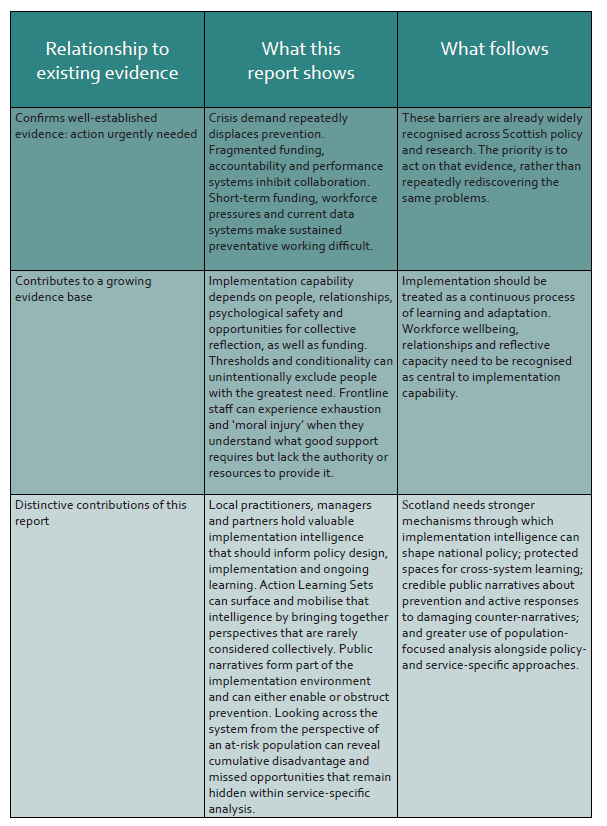
Four particularly fresh insights emerge from this report. First, people working across local systems hold valuable implementation intelligence, yet there are few sustained opportunities to bring this knowledge together or enable it to shape national policymaking. The Action Learning Sets showed how facilitated, cross-system spaces can make this intelligence visible and support collective learning and action, offering a practical approach to policy co-design and implementation. The sets focusing on young adult men also demonstrated the value of examining services from the perspective of an at-risk population, revealing cumulative disadvantage and missed opportunities that service-specific analysis can overlook. Finally, the findings identify public narratives as part of the implementation environment itself. Misinformation and damaging narratives can obstruct preventative work, underlining the need for a more compelling public account of why prevention matters and what it can achieve.
What this means
Scotland has a longstanding commitment to prevention and many of the principal barriers are already well recognised. The findings in this report show how these barriers combine and reinforce one another within local systems, helping to explain why sustained change remains difficult. Strengthening prevention will require greater implementation capability across the system. This includes governance and accountability arrangements that support collaborative working, sufficient workforce capacity, appropriate funding models, strong organisational relationships, better data, protected opportunities for learning, and effective dialogue between local and national levels.
The Action Learning Sets also demonstrated that Scotland already possesses considerable implementation expertise. Participants identified how policies interact with existing services and resource constraints, where unintended consequences arise and where opportunities for change exist. Yet few sustainable mechanisms currently enable this intelligence to inform national policy design, processes for driving and overseeing implementation, or ongoing learning and adaptation.
A particularly important lesson is that no individual organisation holds a complete picture. Looking collectively across housing, health, employability, justice and community services revealed patterns that remained difficult to see from within any single part of the system. This was especially apparent when implementation was considered from the perspective of young adult men at risk of early and preventable death, who use many of the services discussed in the sets. Existing systems were often better at recording separate episodes of service use than understanding the cumulative trajectories through which disadvantage, fractured trust and missed opportunities developed over time.
Recommendations
The findings suggest seven priorities for strengthening Scotland’s implementation capability and creating the conditions for prevention and supporting the maturation of the policy and implementation landscape.
1. Make co-design central to policy design and implementation
At national and local levels, policymakers and system leaders should create sustained, constructively facilitated spaces that bring together practitioners, managers and partners from across relevant systems to co-design policies and the approaches through which they will be implemented. These groups hold essential knowledge about existing demands, service capacity, relationships between policies and the practical consequences of different choices. Their involvement should begin early enough to shape policy design, resourcing, accountability, data and performance arrangements, and continue throughout implementation so that emerging intelligence can inform learning and adaptation. The Action Learning Sets show how this can work locally, making collective learning part of policy design and delivery rather than relying principally on periodic consultation and performance management.
2. Redesign accountability and performance systems to enable collaboration
National and local leaders should identify where siloed funding, accountability arrangements and organisational performance indicators are pulling services in different directions. Many services are working with the same people and could collaborate more effectively if they were tasked with working towards shared outcomes for the people they serve. The current performance management landscape is already cluttered so the aim should be to develop fewer, more collaborative indicators to replace (rather than simply add to) existing reporting requirements for public sector and third sector partners. This would reduce the amount of workforce time invested in performance reporting and support shared responsibility for risk and prevention, reducing reliance on individual relationships to hold collaborative working together.
3. Give staff the capacity and support to make prevention possible
National and local leaders should consider the cumulative demands that new policies place on staff and ensure that expectations are matched by the time, resources, skills and authority needed to deliver them. Repeatedly asking an already overstretched workforce to implement ambitions that cannot be realised under current conditions risks exhaustion, moral injury and loss of confidence in the possibility of change. Supporting staff means maintaining stable teams and strong working relationships, providing effective supervision and psychological support, and protecting time for the relational work, professional judgement and reflection on which preventative practice depends.
4. Build data infrastructure around people’s trajectories to help capture the costs of remaining in crisis-response mode
Data and evaluation need to illuminate how people’s lives unfold across services and over time, alongside routine measures of individual service activity. Better evidence on pathways, cumulative harm, hidden demand and costs falling across housing, health, employability and justice would strengthen the case for preventative investment. This should include developing a clearer account of the human and financial costs and outcomes of not intervening earlier, recognising that preventative investment may produce benefits elsewhere in the system and over longer periods. Achieving these kinds of insights is likely to require regular qualitative insights as well as routinely collected quantitative data.
5. Provide clear leadership and practical support for responsible data sharing
Information sharing should be recognised as an implementation issue, in its own right. Participants described uncertainty about what GDPR (the General Data Protection regulation) permits, defensive interpretations of information governance, and recording systems that erode staff time because they do not communicate with one another. National and local leadership is needed to provide clear expectations and practical guidance, alongside investment in training and support so that staff are confident about what they can appropriately share. Longer-term investment is also needed to reduce incompatible and duplicative recording systems. Participants’ accounts included reflections that ‘GDPR gets used as a shield’, illustrating how uncertainty can obstruct collaboration.
6. Create the funding and learning conditions for local innovation to develop, adapt and inform wider practice
Short-term pilots and funding cycles can generate useful innovation while making sustained implementation, relationship-building and local planning difficult. Funding arrangements should provide sufficient time and stability for organisations to test approaches, learn and adapt. National and local bodies should also build on existing arrangements to create sustained opportunities for local areas to learn with and from one another, including through cross-area learning networks or communities of practice, while collaboratively developing practical guidance or a minimum requirements framework. This should set out the core components associated with effective practice, providing a flexible ‘how-to’ model that supports consistency and quality while enabling adaptation to local contexts and needs. These should enable partners to examine what is working, understand the conditions that have made it possible and consider how learning might be adapted elsewhere. Linked to recommendation 1, stronger ongoing connections between local learning and national policymaking would allow implementation intelligence to inform policy development and adaptation.
7. Treat public narratives as a fundamental part of the implementation environment
National and local leaders should develop and communicate a credible, positive account of prevention: why earlier action matters, how it benefits communities and what people can realistically expect from public services over what time frame. Leaders also need to respond actively when misinformation, stigma or hostile narratives undermine trust, increase risk aversion, harm vulnerable communities or obstruct preventative action. Participants saw public and political narratives as having tangible consequences for implementation, including absorbing resources and narrowing the space for innovation in prevention and earlier intervention.
From learning to action
We purposefully employed an action learning approach to the work reported here since our aim was to help participants and local areas make steps towards prevention, as well as generating the broader insights summarised above. As we report in the later sections, the Action Learning Sets prompted new ideas and activity, as well as shaping and accelerating work already under way. They also fostered relationships, ways of working and ideas that participants are continuing to build on locally. These early changes illustrate the value of bringing different parts of the system together to examine implementation critically and act on what they learn. Sustaining this approach and connecting local implementation intelligence more closely to national policymaking, could help Scotland make greater progress towards its ambitions for prevention.
Introduction
Few ideas command broader support in Scottish public policy than prevention. For over 15 years, preventing problems before they escalate has been a central ambition across Scottish Government, local government, Audit Scotland, the NHS and many third sector partners. Earlier intervention can improve outcomes for individuals and communities, make better use of public resources and reduce the likelihood that disadvantage accumulates across the life course [3–11]. Prevention therefore offers one of the most promising routes to reducing Scotland’s persistent health inequalities. [5, 6] [12, 13]
Despite this broad consensus, health inequalities remain stubbornly wide in Scotland, while demand for many services continues to rise, contributing to growing pressure on public finances. [6, 8, 14–18]
All this raises an important question: if there is such widespread agreement about the importance of prevention, why has it proved so difficult to realise and sustain in practice?
This is the central question underpinning this report. We hope the insights and ideas presented here support decisions that enable much greater progress towards prevention in the next few years.
Understanding Policy Implementation
Implementation is sometimes treated as the stage that begins once a policy has been designed. In practice, policies continue to take shape as they are interpreted, negotiated and adapted across different organisations, professional roles, local contexts and populations. Their practical effects are shaped by relationships, resources, accountability arrangements, institutional histories and the ways in which policy problems have been framed and understood [19–25].
Understanding why sustained commitment to prevention has not produced greater change therefore requires attention both to policy design and to what happens as policies are put into practice [19]. The Welsh Centre for Public Policy’s review, Implementation-minded policy making, argues that policy development should draw on detailed knowledge of the problem and the contexts in which action will take place [20, 21]. Attention to implementation should begin during policy design and continue throughout the policy process. This requires clarity about the problem, the intended changes and how they are to be achieved, alongside careful consideration of how a policy will interact with different implementation contexts [21].
While hard to disagree with the prescription, earlier research highlights the strategic value of ambiguity in policymaking. Policymakers may deliberately give key policy ideas ‘chameleonic’ qualities because this malleability helps bring together people and organisations with different interests and interpretations [22]. This can support agreement around an overarching ambition while leaving important tensions unresolved. Recent research examining attempts to operationalise inclusive growth in Scotland illustrates how these tensions can subsequently make it difficult to translate broad support into coordinated action [26].
This tension is evident in current understandings of prevention. McNulty, for example, identifies two distinct conceptions of prevention operating within current Scottish policy: Christie’s emphasis on structural transformation and community empowerment, and the primary, secondary and tertiary classification used in recent preventative-spend guidance [27]. Treating these as interchangeable can obscure important differences in what prevention is intended to achieve, what activities are counted as preventative and what changes implementation requires.
Complicating matters further, implementation research draws attention to the range of influences that shape what happens once policies encounter existing systems. These include stakeholder involvement in policy design, organisational hierarchies, professional judgement, coordination across networks and the responses of frontline staff [24, 25]. Policies are interpreted and operationalised differently across places and tiers of governance, bringing an unavoidable degree of complexity and unpredictability [19]. These interactions can generate unintended consequences within or beyond the policy area in which an intervention originates. Such effects can be particularly difficult to recognise where responsibility, monitoring and accountability are fragmented across organisations or policy domains [28].
These considerations are particularly relevant in Scotland, where implementation involves national and local government, public bodies, regulators, professional networks, third sector and community organisations, and frontline staff. As Barrett and Fudge 2026 (1981: 9) observe, ‘policy does not implement itself’ [29]. Policies acquire meaning and produce effects through the interaction of actors, resources, relationships, power, accountability arrangements, institutional histories and established understandings of the policy problem [29–33]
Implementation-focused analysis therefore needs to examine the ideas and assumptions embedded within policies, including the different understandings that an idea such as prevention can accommodate, as well as the systems through which policies are put into practice. This broader lens can reveal how ambiguity, context and relationships shape implementation, help anticipate consequences across policy areas and populations, and support learning and policy adaptation.
This report develops arguments set out in SHERU’s Making Prevention Real [34] drawing on evidence from the Action Learning Sets to examine how implementation challenges are experienced within local systems and how implementation intelligence might be used to address them.
The Policy Context for Prevention and Implementation
Renewed ambitions for prevention
Scotland’s longstanding commitment to prevention has been renewed across several major national policy developments. The Scottish Government’s five-year Programme for Government, Ambitious for Scotland, sets out its priorities for improving public services and outcomes over the parliamentary term[1]. Its longer-term approach, supported by annual delivery plans aligned with future budgets, has the potential to provide greater continuity between policy ambition, investment and implementation. Recent SHERU analysis of the Programme for Government highlights its potential to support a longer-term approach to prevention and health inequalities. While recognising that there may be a rationale for the proposed NHS and local government reorganisation, it argues that public service reform should be judged by whether it strengthens collaboration, prevention and action on the social and economic determinants of health, and notes the risks around capacity and focus that are often associated with organisational reform [35].
The Programme for Government sits alongside the Population Health Framework, the Health and Social Care Service Renewal Framework and the Public Service Reform Strategy [1, 5, 12, 36]. Together, these documents consistently emphasise prevention, earlier intervention, collaboration and more sustainable public services. The Population Health Framework places a prevention-focused system at the centre of efforts to improve population health and reduce health inequalities. It includes commitments to embed prevention within planning, delivery, budgets and accountability, supported by stronger collective responsibility for population health outcomes at national and local levels [5]. The Public Service Reform Strategy similarly recognises that existing funding, accountability, reporting and data arrangements do not always support the collaborative and preventative approaches Scotland is seeking to develop[36]. The Health and Social Care Service Renewal Framework addresses the sustainability of health and social care [12], while the Verity House Agreement provides a wider commitment to partnership between Scottish and local government, local flexibility and shared accountability for outcomes [37].
Understanding what effective implementation of ‘prevention’ entails requires attention to how the idea is interpreted and operationalised. These interpretations shape which activities are prioritised, the scale and type of change expected, and how spending and progress are assessed. Where these choices remain implicit, organisations may pursue different versions of prevention under the same broad commitment, making a coherent shift in delivery more difficult to achieve.
Implementing preventative policies under pressure
These renewed commitments to prevention are being pursued within an increasingly difficult environment for public services. The Scottish Fiscal Commission has highlighted the longer-term sustainability challenges facing Scotland’s finances, while Audit Scotland has warned that growing demand and financial pressures are placing the sustainability of local government services at risk [15, 18]. These pressures are prompting difficult discussions about the future of public services and the relationship between policy ambition, available resources and delivery capacity.
Such concerns were prominent in policy discussions surrounding the 2026 Scottish Parliament election, placing a spotlight on pressures across the NHS, health and social care, housing and other public services [38, 39]. Published ahead of the election, the Royal Society of Edinburgh’s Policy in Practice: How Scotland Can Get It Right highlighted a recurring gap between policy intention and implementation across several of Scotland’s principal policy challenges [39]. Its authors, Thompson and Macpherson, argue that addressing this gap requires clearer ownership of outcomes, realistic assessment of delivery capacity and transparent acknowledgement of the choices and trade-offs involved. The Scottish Parliament’s first debate on public service reform following the election, held in June 2026, reflected many of the same concerns [40].
The immediate fiscal outlook adds to these challenges. The Scottish Fiscal Commission’s August 2026 update identified pressures associated with global energy and food prices, wider inflation and savings already anticipated through the Scottish Spending Review [41]. These factors create a difficult setting in which to sustain existing services, invest in prevention and implement new commitments.
It is also important to recognise that public services are responsible for delivering an extensive and interconnected range of existing ambitions. These include increasing the supply of affordable housing, supporting a just transition to Net Zero, implementing community wealth building and meeting Scotland’s child-poverty targets [42–45]. Progress in each area is likely to affect demands, resources and outcomes elsewhere. Implementation therefore requires coordination across portfolios, organisations, levels of government, places and populations.
The signs are not necessarily promising. ‘Prevention Under Pressure’, a report produced collaboratively by Scottish Communities for Health and Wellbeing, the Health and Social Care Alliance Scotland and Community Health Exchange, reports findings from a survey of 67 community-led health organisations and a subsequent workshop [46]. More than half of respondents said that relationships with public health partners had worsened since 2022, while nearly half reported no co-productive working and 69% felt that public health partners did not understand their capacity and resources. Organisations described shrinking and insecure funding alongside rising demand and increasingly complex, sometimes crisis-level referrals from statutory services. The report argues that these conditions work against the emphasis on prevention and collaboration within the Population Health Framework, the Health and Social Care Service Renewal Framework and the Public Service Reform Strategy [5, 12, 36, 46].
This combination of fiscal constraint, growing and increasingly complex demand, and an extensive range of existing commitments has significant implications for implementation. Adding further ambitions without sufficient attention to delivery capacity risks increasing pressure on services and staff, weakening coordination and widening the gap between national commitments and communities’ experiences. Sustaining the credibility of Scotland’s preventative ambitions will require clarity about priorities and trade-offs, attention to how policies interact, and realistic assessment of the resources and capabilities needed to implement them. While prevention spending frameworks can help signal intent and track progress, tracking expenditure alone is insufficient to deliver a meaningful shift towards prevention and must be accompanied by wider changes to policy, practice and system incentives [47, 48].
Connecting national ambition and local implementation
Several major reviews already identify implementation as central to Scotland’s prevention challenge. The Health Foundation’s Leave No One Behind review found broad agreement among stakeholders that Scotland faced a persistent ‘implementation gap’ between ambitious policy intentions and improvements in people’s everyday lives. It called for greater attention to the conditions that enable effective implementation [6]
The Auditor General for Scotland, Stephen Boyle, has similarly observed that ‘audit work consistently shows a major implementation gap between policy ambitions and delivery on the ground’ [14]. The Scottish Government’s review of 25 years of preventative interventions concludes that progress depends on sustained collaboration, effective implementation and continuous learning across organisations [49]. Scotland therefore has substantial evidence about the broad nature of the challenge.
There is, however, more of a gap in understanding around how these pressures and barriers combine within local implementation settings, and how knowledge generated through implementation efforts can contribute to policy development and wider learning. Earlier work by What Works Scotland similarly identified participation, partnership, governance, workforce, leadership, prevention, place and evidence as central to public service reform[50]. It also emphasised the importance of relationships, organisational cultures and ways of working in determining whether reform succeeds [50].
This report addresses that gap by examining how preventative ambitions are experienced, interpreted, supported and constrained within local systems. Working with the City of Edinburgh and North Lanarkshire, we used Action Learning Sets focused on housing, employability and young adult men to bring together practitioners, managers and partners with different perspectives on implementation. Our sense is that this work provides a ‘metaphorical mirror’ on the day-to-day realities of implementing preventative policy within complex and pressured systems.
The findings are intended to support learning across policy and practice, rather than assess the performance of any specific participating organisations or services. The insights raise a central question for Scotland’s emerging approach to prevention and public service reform: if those responsible for implementing policy understand many of the barriers so well, how can Scotland make more systematic use of their knowledge?
We propose that making better use of this implementation intelligence could strengthen policy design, implementation and ongoing adaptation at national and local levels. It could also help distinguish between opportunities for change within local systems and the wider funding, accountability and policy conditions that require national action.
SHERU’s Approach
To maintain the focus of this report on the substantive findings and their implications for policy and practice, methodological detail is provided in an Appendix. This section simply provides a brief introduction to the approach we used and some reflections on our approach to analysis.
Why Action Learning?
SHERU’s previous work has examined how Scotland’s national policy ambitions for improving housing and employability might be expected to reduce health inequalities [51, 52]. These analyses highlighted the ambitions of national policies relating to key building blocks for health but also raised important questions about implementation. For example, while Housing to 2040 sets out an expansive and ambitious vision for improving housing and reducing inequalities in decent housing, assessments have consistently highlighted limited attention to implementation [51]. In contrast, Scotland’s employability strategy, No One Left Behind, appears to address only part of the employability challenge, focusing primarily on labour supply rather than the wider demand-side, labour market conditions that shape access to good work[52]. These analyses therefore identified important but distinct implementation challenges, though analysing national policies nonetheless tells us little about how these challenges are experienced by those responsible for translating policy into practice. Addressing these questions requires a different, implementation-focused lens.
Action Learning Sets were selected as the principal approach for this strand of the research because they offered a complementary perspective to more commonly used analyses of quantitative indicators of investment, delivery and outcomes. Whilst these forms of evidence are essential for understanding policy problems and population trends, they cannot tell us how implementation unfolds in practice, why ambitious policies become constrained, and what practitioners believe would enable better outcomes and a preventative shift. Action learning enabled us to explore implementation through the experiences of those responsible for making policy work. It encouraged participants not only to work through challenges they face in their roles but also to identify practical actions that could be taken within their own organisations and partnerships, and to reflect collectively on the wider organisational and national changes they believe are needed to enable a more preventative system.
Participants included practitioners, managers and leaders from local government, the NHS, the third sector and national organisations involved in implementing housing, employability and prevention policy (see Appendix A for further detail). Each Action Learning Set deliberately brought together people with different vantage points across the system who would not routinely have opportunities to reflect together in their day-to-day roles. Bringing together these different perspectives enabled implementation to be understood in ways that would not have been possible from any single organisational viewpoint. SHERU’s approach has affinities with What Works Scotland’s collaborative action research, which brought practitioners together to support learning and action while generating insight into the operation of public service reform [53]. However, the study reported here used topic-focused Action Learning Sets across two local authority areas, with particular attention to the implementation intelligence they generated and its relevance to local and national policy. Participants connected experiences that are often considered separately, developing a richer understanding of how implementation challenges emerge across organisations, sectors and levels of governance. Throughout the programme, a SHERU researcher attended every Action Learning Set, contributing to discussions, supporting facilitation where appropriate, recording observations and maintaining ongoing dialogue with participants between and following sessions.
Each Action Learning Set met four times over approximately three months. Sessions centred on real, ‘live’ implementation challenges brought by participants themselves rather than hypothetical scenarios. Facilitation focused on creating psychologically safe spaces that encouraged open reflection, respectful challenge and, where appropriate, radical candour. Participants were encouraged to ask questions before proposing solutions, to explore issues from one another’s perspectives and to reflect on how different parts of the system shaped the challenges they encountered. Rather than defending organisational positions, the emphasis was on collective inquiry into how implementation worked in practice and what might help it work better.
Alongside discussion, participants were invited to identify the ‘elephants in the room’, with some using post-it notes on an elephant shaped board. These were the wider factors that everyone recognised as shaping implementation, but which were not always part of the immediate conversation or lay beyond participants’ direct control. For example, wider resource pressures, national policy decisions or structural features of the system. Making these ‘elephants’ visible helped participants distinguish between the practical actions they could take locally and the wider changes they believed would be required nationally to support a more preventative system. The ‘elephants’ also formed part of the study data and informed the subsequent analysis.
Action Learning was selected because it served two complementary purposes. First, it generated rich evidence about implementation by enabling participants to examine policy through the experiences of those charged with making it work in practice. Second, it created opportunities for collective learning and practical action, supporting participants to strengthen local implementation while identifying the wider changes needed to support prevention nationally. Participants articulated the value of this approach simply – the sets provided spaces for honest conversations about the challenges in the current system:
“This isn’t a space where you’re expected to have the answer. That makes it easier to be honest about what isn’t working.”
“This is the first time I’ve been able to talk about what doesn’t work without feeling defensive.”
While the idea is far from complicated, participants often reflected that similar spaces did not currently exist in their day-to-day working lives:
“We don’t get space to talk about the damage the system does – only what it delivers.”
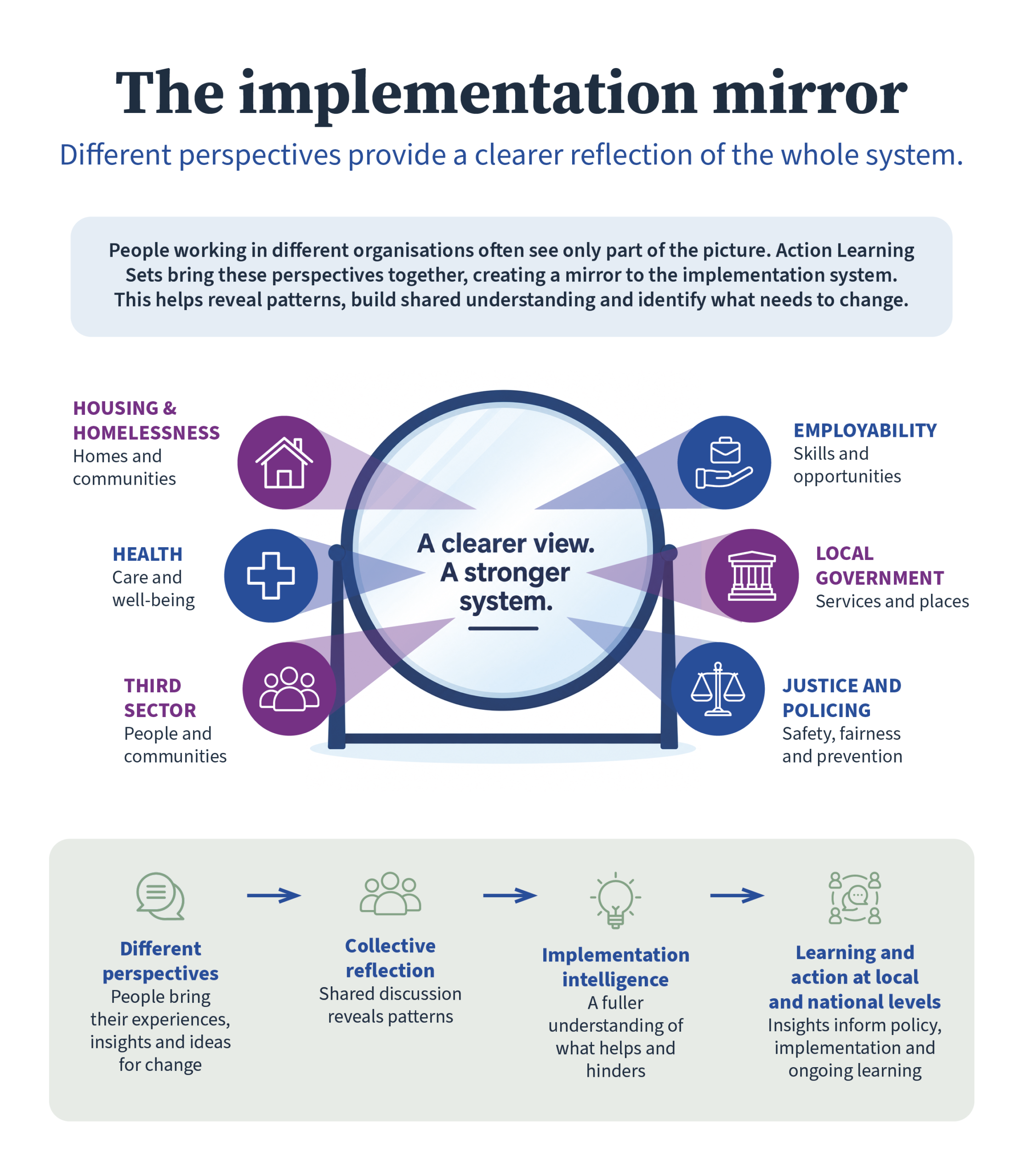
Across the Action Learning Sets, practitioners, managers and partners from local government, health and the third sector were given a rare opportunity to step outside day-to-day operational pressures and reflect collectively on the wider system. For SHERU, the Action Learning Sets offered a metaphorical mirror (see Figure 1) into the realities of implementation: revealing not only the pressures, constraints and trade-offs that shape ambitious policies in practice, but also the considerable insights that exist within the public and third sector organisations operating locally in Scotland. This combination of inquiry, collective reflection and practical action made Action Learning particularly well suited to investigating the implementation puzzle at the heart of this report.
Figure 1: The Implementation Mirror
Data and Analysis
The analysis drew on multiple sources of evidence from each Action Learning Set. During every session, a dedicated note-taker produced detailed notes of the discussion. Following each session, the facilitator produced additional reflective notes, while the SHERU staff member attending each Action Learning Set also recorded their own observations and reflections. As part of the Action Learning process, participants were encouraged to keep their own reflective notes throughout; this included notebooks for participants which we treated as confidential and did not read, as well as notes that were shared with the research team, which formed an additional source of insight. We also drew on material generated during the sessions, including the ‘elephant in the room’ exercise, which enabled participants to capture important issues that lay beyond the immediate discussion or outside their direct sphere of influence but were essential factors in understanding challenges. Quotations presented throughout the report are drawn from detailed contemporaneous notes rather than audio recordings. They reproduce participants’ words as captured by the note-takers, although some have been lightly condensed or edited for readability without changing their meaning. Draft findings containing a selection of these quotations were subsequently shared with participants, giving them an opportunity to question or correct how the discussions had been represented.
Our approach to analysing this extensive textual data was iterative and involved Community Renewal Trust and SHERU researchers working in parallel. Community Renewal Trust undertook an initial analysis of each Action Learning Set on a topic-by-topic basis, identifying the principal themes emerging within each topic and reflecting on similarities and differences between topics and areas. In contrast, SHERU undertook a cross-cutting analysis across all six Action Learning Sets in which we focused on identifying implementation challenges and opportunities that recurred across different places, topics and organisational perspectives using a coding framework on Nvivio. Throughout the analysis, we sought not only to identify implementation challenges but also to understand how participants sought to overcome these challenges and what this revealed about opportunities for strengthening prevention.
In observing set conversations and undertaking this analysis, we were struck by the extent to which similar implementation challenges emerged across the different Action Learning Sets. While some important local and thematic differences remained, the consistency of key insights informed our decision to organise this report around the six cross-cutting implementation challenges that appeared to be shaping prevention across contrasting local systems and policy areas.
We checked our emerging interpretation in three ways. First, emerging findings were independently reviewed by a SHERU researcher with access to all notes who had not participated in the Action Learning Sets, providing an external check that helped ensure our analysis was grounded in the data we had gathered. Second, we reconvened the sets to sense-check our emerging findings with participants, having shared a draft report and presentation. Not every participant could make these meetings (and some had changed roles) so we also had some individual follow up conversations, focusing especially on participants who had committed to taking actions forward. Third, we shared the findings (via presentations and discussions) with senior leaders in both local areas. These conversations enabled us to test whether the findings resonated with participant and broader local experiences, identify any important omissions or alternative interpretations, and refine the analysis accordingly. In short, our analytic approach combined within-set interpretation, with cross-set comparison, independent scrutiny and sense-checking with participants and local areas.
Throughout the programme, participants gave generously of their time, insights and experience despite demanding professional roles and considerable operational pressures. Their willingness to reflect openly, challenge one another constructively and share both frustrations and examples of positive change made the Action Learning Sets a particularly rich source of learning and underlined the considerable implementation intelligence that exists within Scotland’s public and third sectors.
In feeding back on an earlier version of this report, participants seemed content that we had accurately captured the key issues discussed in their set, though some noted that the initial report was ‘a difficult read’ in terms of surfacing the pervasiveness of many challenges. Our subsequent discussions with local partners therefore focused on opportunities for addressing some of these challenges and strengthening the shift towards prevention. The ensuing commitments and actions being taken in each area are captured in the later sections of this report.
Understanding the local implementation contexts
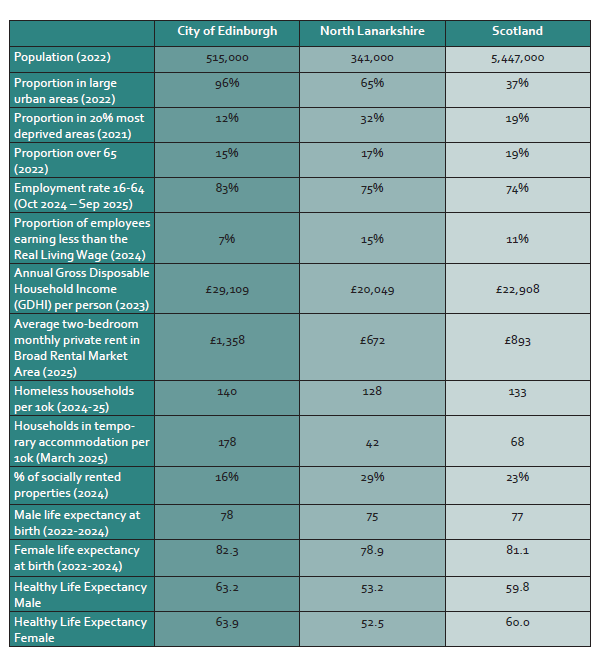
Edinburgh and North Lanarkshire were selected partly because of their commitment to working collaboratively to achieve a shift towards prevention, their desire to work with SHERU on this and our sense they each had leaders who were curious, open to challenge and keen to find ways of improving life for their local populations. However, we were also seeking to identify two contrasting local implementation contexts so, alongside early conversations with potential areas, we considered the key statistics summarised in Table 2. These statistics help illustrate key differences.
Table 2: Key Statistics for City of Edinburgh and North Lanarkshire Populations
Sources: NRS, 2025, Subnational Population Projections: 2022-based; Scottish Government, 2024, Scottish Government Urban Rural Classification 2022; NRS, 2022, Population estimates by Scottish Index of Multiple Deprivation (SIMD); Scottish Government, 2025, Private Sector Rent Statistics, Scotland, 2010 to 2025; Scottish Government, Homelessness in Scotland: 2024-25; ONS, 2026, LI01 Regional labour market: local indicators for counties, local and unitary authorities; NRS, 2025, Life Expectancy in Scotland, 2022-2024. NRS, 2026, Healthy Life Expectancy, 2022-2024 SG, 2026, Housing Statistics 2025: Key Trends Summary
The City of Edinburgh represents a large urban authority with a relatively young population. Headline indicators point to a strong labour market, with comparatively high rates of employment and pay, resulting in average levels of income that are significantly above the average for Scotland. However, this strength is accompanied by acute housing pressures, manifesting in exceptionally high demand for temporary accommodation. North Lanarkshire, a former industrial area, by contrast, reflects a more mixed urban and semi-rural authority, with a lower life expectancy and more of the population living in deprived areas compared to both Edinburgh and Scotland as a whole. Housing affordability pressures are generally less acute, with a lower rate of homelessness, but low pay is more prevalent, and household income is below the national average (albeit improving).
Our working assumption was that these contextual differences might lead to distinct implementation challenges. As the findings demonstrate, many implementation issues proved remarkably consistent across both places, suggesting they reflect broader features of Scotland’s implementation environment rather than local circumstances alone. Nonetheless, there are some notable differences in the ways national policy ambitions are interpreted, negotiated and enacted within local systems that are shaped not only by the kinds of contextual factors outlined in Table 1 but also by organisational cultures, local histories, governance arrangements, service pressures, relationships and perceptions of influence. All of this helps us consider where conclusions and implications need to be particularly sensitive to local context.
In the following sections, we briefly summarise our reflections on the factors that made each locality distinctive.
Edinburgh
In Edinburgh, implementation discussions were strongly shaped by the city’s housing emergency and the extent to which housing pressures were influencing outcomes across multiple policy domains. Participants described an operating environment characterised by sustained demand pressures, significant public and political scrutiny, and the need to balance immediate crisis response with longer-term ambitions for prevention and system change. From the outset, discussions were characterised by a strongly collaborative culture. Local government colleagues worked alongside NHS and third sector partners throughout the Action Learning Sets, reflecting well-established partnership arrangements and a shared commitment to tackling complex challenges collectively. Despite well-developed arrangements for local-national engagement, participants identified a continuing opportunity to strengthen the connection between policy intent and implementation experience, ensuring that local insights, evidence and learning can more effectively inform strategic decision-making and system development.
Several interconnected implementation dynamics were identified:
- heightened attention to housing demand and its wider implications for employability, health and community outcomes;
- strong partnership infrastructures, with NHS and third sector organisations routinely involved in strategic discussions;
- a dense landscape of strategic forums, research activity and collaborative initiatives, creating a regular flow of new ideas and evidence;
- close physical proximity to national government and other national stakeholders, the parliament and media, which contributed to a sense of being easily scrutinised;
- growing fatigue associated with repeated cycles of reform and transformation activity.
A recurring theme was the challenge of navigating complexity within an already crowded governance environment. Participants described a system attempting to pursue long-term transformation while simultaneously responding to immediate and escalating demand pressures. Housing was frequently cited as an example of this tension, where the challenges of balancing immediate service pressures with longer-term preventative ambitions were particularly evident, illustrating how resource constraints can shape prioritisation decisions across the system.
In set discussions, we noted that many people working within the city’s partnerships had previously worked elsewhere in Scotland or beyond, bringing experience of different organisational cultures and ways of working. Alongside the city’s extensive links with universities, national organisations and research programmes, this contributed to a continual flow of new ideas and evidence. However, participants also reflected on the challenges of navigating such a busy policy environment. The sheer volume of meetings, initiatives and scrutiny, including regular engagement with national bodies, could contribute to information overload and, at times, make it more difficult to sustain relationships and maintain momentum for change.
Despite Edinburgh’s overall prosperity, participants repeatedly reflected on the risk that city-level indicators obscured significant inequalities within communities. There was a strong sense that aggregate measures often fail to capture the lived realities of deprivation experienced within parts of the city. Related to this was a concern about the spatial dimensions of inequality and perceptions of exclusion. Some participants argued that longstanding patterns of urban development continue to shape how communities experience public investment and access to services. This was linked to wider concerns about trust, visibility and representation, with participants suggesting that some forms of disadvantage remain insufficiently recognised within public and strategic discourse.
North Lanarkshire
In North Lanarkshire, there was no declared local housing emergency, leading to different policy context for trying to achieve national and local housing ambitions. Participants nonetheless reported that North Lanarkshire faces similar pressures to many other local authority areas around increasing demand for affordable homes, constraints on housing supply, and rising levels of housing need and challenges.
Discussions in North Lanarkshire were characterised by a strong focus on system infrastructure, accountability and delivery mechanisms. Participants frequently examined how organisational structures, funding arrangements, performance frameworks and evidence requirements shape decision-making and influence local implementation. Whereas Edinburgh’s discussions often reflected a wide network of external partnerships, participants in North Lanarkshire frequently described long-standing relationships with one another and with the communities they served. Many had lived and worked in North Lanarkshire for much of their lives, and participants explained that Council leaders actively encouraged staff to live locally, where possible. This contributed to a strong sense of local knowledge, shared history and commitment to place.
Several distinctive features emerged:
- a strong emphasis on accountability and performance management;
- concern about incentive structures unintentionally prioritising short-term outputs;
- active efforts to strengthen collaborative working across different services and NHS partners;
- recognition of operational barriers, including fragmented systems and challenges relating to information sharing.
- Implementation discussions often centred on the practical workings of systems and the extent to which existing structures enable or constrain collaborative responses to complex needs. Participants demonstrated a strong appetite for more integrated approaches to supporting communities experiencing multiple disadvantages. However, there was also recognition that established governance and accountability arrangements can create challenges for cross-sector working and longer-term investment in prevention.
Participants frequently referred to The Plan for North Lanarkshire [54] and its role in shaping local priorities. There was a sense of shared purpose across many organisations, together with well-established working relationships. At the same time, some participants questioned whether existing structures, resources and incentives were sufficient to realise the council’s ambitions. This occasionally gave rise to a degree of scepticism about the gap between strategic aspirations locally and the scale of change participants felt would be required to make a lasting difference for communities experiencing multiple disadvantage.
Findings: What local implementation insights tell us about prevention
The findings are organised into three parts. The first introduces six cross-cutting implementation challenges that recurred across our two local areas and three Action Learning Set topics (preventing homelessness, supporting employability and young adult men). The second explores challenges that seemed more specific to these topics, and outlines the individual, local and national actions participants identified as enabling a greater shift towards prevention. The final section provides a brief overview of the action learning we are aware is being taken forward. Together, these findings illustrate how common implementation issues interact with distinctive opportunities and constraints to shape Scotland’s journey towards prevention.
Six Cross-cutting Insights
Finding 1: Why does crisis keep displacing prevention?
Prevention was widely valued by participants (and, many suggested, their immediate colleagues) but the time and resources needed to do preventative work was rarely protected. Many noted how difficult it felt to try to drive prevention within systems and processes organised around responding once problems have escalated.
Across the Action Learning Sets, conversations almost always began with prevention. Housing practitioners, employability advisers, NHS colleagues, third sector partners and local managers all saw the value of intervening earlier to improve people’s lives, prevent disadvantage accumulating over time and reduce health inequalities. Whether discussing housing, employability or support for young adult men, there was little disagreement about the direction Scotland has been aiming for. Those involved could readily identify where earlier intervention might have changed people’s trajectories and reflected on the difference it would make if prevention could be achieved at greater scale. Housing practitioners, in particular, frequently identified earlier moments at which different decisions or stronger coordination between services might have altered people’s trajectories, for example around hospital discharge, release from prison or relationship breakdown, but discussed how difficult it had become to intervene consistently at these points.
As discussions developed, however, attention shifted from policy ambition to the realities of implementation. Across very different services, practitioners described working within systems under sustained pressure, where immediate risk, statutory responsibilities, waiting lists and rising demand continually competed with longer-term preventative work. In short, while participants agreed that prevention mattered, they struggled to enact and sustain preventative approaches within services organised around responding to crisis. One practitioner summarised this tension simply:
“We say prevention is the priority, but most of our energy goes into managing risk once everything has escalated.”
This perspective recurred across all six Action Learning Sets. In explaining this tension, practitioners connected housing shortages, poverty, insecure employment, unmet health needs, workforce pressures, funding uncertainties and increasing complexity of need. These factors interacted to shape everyday decisions about what could realistically be prioritised (see also the discussion of thresholds in Finding 3). Local innovation and preventative practice were evident, but participants often described these as incremental responses or small-scale innovations within systems whose overall direction remained shaped by crisis demand.
The Action Learning Sets focusing on homelessness prevention brought these dynamics into sharp focus. Here participants often reflected on feeling there was a particularly large gap between the preventative ambitions of Housing to 2040 [55]and the current national housing emergency [56] especially in Edinburgh which (unlike North Lanarkshire) had also declared a local housing emergency [57, 58]. These tensions were generally viewed as having developed over a long period:
“[it is a] whole broken system – underfunding, under focussed…an emergency decades in the making”.
“It’s an emergency, but not a sudden one”.
Positioning Scotland’s housing emergency as an ‘elephant in the room’, participants considered recent policy developments, including Ask and Act, the new duties under the Housing (Scotland) Act 2025 [59] that require named public bodies to ask about people’s housing circumstances and take reasonable steps when they identify a risk of homelessness. In August 2025, the Scottish Government announced it was investing £4 million funding for organisations to pilot new approaches to the Ask and Act duty [60]. With a short deadline of mid-October 2025, ideas for the pilots also formed part of discussions in North Lanarkshire, where the timeline coincided with sets. However, while participants recognised the potential of this approach, they also highlighted the difficulty of introducing new preventative activity within services already struggling to meet immediate needs. Against the backdrop of the national housing emergency, and Edinburgh’s local housing emergency, many reported that support was increasingly concentrated on people with the highest levels of need. By the time statutory thresholds were reached, people’s circumstances had often deteriorated significantly and opportunities for meaningful prevention had passed (see also Finding 3):
“By the time someone meets the threshold for housing, the opportunity to prevent homelessness has usually already passed.”
Across all discussions, there was clear recognition of housing as a fundamental determinant of health so there was an implicit acknowledgement that this situation was likely to be contributing to health inequalities.
Several practitioners also reflected on a less visible consequence of threshold-based systems which is that the requirements for meeting the threshold themselves consume resources. Assessing eligibility, gathering evidence, documenting decisions and demonstrating compliance with funding requirements required substantial staff time across many services. Participants questioned whether these activities always represented the best use of limited capacity, particularly where the same individuals were repeatedly being assessed by different organisations against different eligibility criteria. In their view, implementation systems were often investing considerable effort in determining whether people qualified for support, rather than enabling practitioners to provide support. For example:
“We are given funding by the council to support homelessness, but we lose so much time providing evidence that the service users are eligible for the support.”
The discussions also demonstrated how implementation challenges rarely remained within a single policy area. Housing services increasingly found themselves responding to needs rooted in trauma, poor mental health, addiction, justice involvement and social care. This reinforced participants’ view that responding effectively to crisis requires coordinated action across multiple services, while also illustrating how pressures in one part of the system quickly create additional pressures elsewhere (see Findings 2 and 6).
The Action Learning Sets focusing on young adult men revealed a similar pattern from another vantage point. Those working with young men described services becoming involved only after earlier signs of distress or instability had developed into homelessness, substance use, violence or involvement with the justice system:
“You don’t meet them when things are wobbling – you meet them when everything has already fallen apart.”
“We wait until behaviour becomes criminal before we respond.”
These observations came from practitioners who could describe earlier opportunities for support in considerable detail. Many strongly supported Scotland’s investment in early childhood and family intervention but expressed concern about adults who had already passed through childhood without benefiting from those earlier preventative investments and who remained at particularly high risk of poor outcomes.
Across the set discussions, practitioners repeatedly returned to the challenge of moving beyond isolated examples of effective practice and small-scale initiatives (e.g. funded via pilot schemes and short-term resources). There was some consensus that Scotland has many examples of innovative local responses but is less good at sustaining successful approaches over time or scaling these up, especially in the context of limitations around organisational capacity and short-term funding. Questions of scale and the infrastructure to support learning and sustaining good practice therefore became as important as questions of innovation in many set discussions.
Finding 1: Key implementation insights
- Across all six Action Learning Sets, practitioners shared a strong commitment to prevention and could identify where earlier intervention was most likely to improve outcomes.
- However, rising demand, statutory responsibilities and workforce pressures repeatedly reduced the time and capacity available for preventative work.
- Consequently, prevention is rhetorically prioritised and supported by some new national policy developments (e.g. Ask and Act) but it still remains challenging to protect resources to enable the thinking and work required to pursue more preventative approaches.
- Reflecting on current practices, housing practitioners demonstrated how opportunities for prevention narrowed as thresholds rose in the context of service pressures, resulting in services that are increasingly focused on acute need. This is pulling key services (notably housing) towards crisis response rather than prevention.
- Practitioners identified examples of successful local innovations contributing to prevention but questioned how these could be sustained or expanded within current implementation conditions.
Finding 2: Why does collaboration remain so difficult when everyone agrees it matters?
The set discussions suggest that people and problems move across organisational boundaries far more easily and often than the resources, authority and accountability needed to respond to these transitions. Conversations across the Action Learning Sets frequently acknowledged the fact people are often interactive (or in need of support from) multiple organisations. Housing practitioners, NHS staff, employability advisers, local managers and third sector partners all described examples of effective partnership working and spoke positively about the relationships they had built across organisations. Few questioned the importance of working together. Instead, discussions focused on the practical difficulties of sustaining collaboration within systems that continued to organise funding, accountability, information and performance through individual organisations and services. One employability practitioner illustrated this challenge succinctly:
“When the NHS gets money, it commissions itself. When the NHS make referrals, the money never follows. [The Third Sector] when we get money, we pass it on.”
Although the above reflection was made in relation to employability, this observation captured a much wider pattern that emerged across all six Action Learning Sets. Participants repeatedly described people (and the problems they faced) moving across organisational boundaries, while the resources, authority and accountability needed to respond to cross-cutting needs remained organisationally siloed. As a result, practitioners described community members ‘pinballing’ between services. Housing, health, employability, justice and community organisations were frequently working with the same individuals but through different eligibility criteria, funding arrangements and performance measures, with each service addressing one part of the problem while no part of the system was responsible for the person’s whole trajectory or intersecting needs. While participants described many examples of effective collaboration, they also reflected that the wider system remained orientated around organisational responsibilities rather than people’s lives.
Under these conditions, participants suggested that organisations sometimes worked to transfer risk across organisational boundaries rather than taking steps to resolve risk collectively. When people were positioned as the responsibility of one service (rather than another), information, accountability, authority and resources rarely moved with them. The result was that no single organisation felt able, or empowered, to address the person’s wider patterns of need or consider which combination of support services might be most effective.
Thus, those working in employability described spending much of their time supporting people experiencing poor mental health, housing instability and trauma while waiting for help from elsewhere. Housing practitioners similarly described responding to complex needs rooted in health, addiction, justice and social care. Rather than reflecting isolated examples of role expansion, practitioners viewed these as predictable consequences of system pressures. As one employability practitioner reflected:
“We’re delivering employability, but most days we’re doing crisis containment.”
Another described the missing connection between services:
“Mental health support is the missing piece…and employability absorbs the impact.”
Across the discussions, practitioners repeatedly described services gradually ‘morphing’ into functions they had never been designed or funded to undertake because other parts of the system seemed unable to respond.
“Lots of organisations, morph into things that other places are better placed to provide.”
Participants repeatedly described local services adapting to absorb these pressures rather than resolving the underlying causes or finding more appropriate support services. Further work is needed to assess whether these situations arise because appropriate services are not available (or accessible, when needed), which was the view of many of the set participants, or whether there is simply a lack of awareness or publicised local support services (which was the view of some national stakeholders with whom we shared these findings).
Linked to this, questions of accountability featured prominently. Participants described ambitious national strategies promoting collaboration and shared outcomes while experiencing accountability systems that remained predominantly organisational and compliance driven. This often-created uncertainty about who held responsibility for addressing complex issues that crossed organisational boundaries. Several participants captured this uncertainty directly:
“Who has the accountability for homelessness?”
“Who is actually in charge? Health boards? Local authorities? Scottish Government?”
One local manager reflected on a discussion about an underperforming service:
“I was in a meeting… someone says, ‘who is actually accountable for this?’ and a colleague said ‘we are all accountable’. But we can’t point to any one person who is actually accountable or taking that accountability.”
Rather than encouraging collective ownership, practitioners felt current arrangements sometimes diffused responsibility across organisations while leaving no single part of the system able to address wider patterns of need. Participants linked this to funding arrangements, reporting requirements and performance management systems that continued to reinforce organisational rather than shared objectives.
For example, a participant in one of the sets focusing on young adult men reflected that current performance indicators unintentionally reinforce organisational boundaries. He argued that organisations working with many of the same people should be asked to develop collaborative KPIs and shared outcomes to encourage services to work together to support key population groups:
“The way KPIs are developed and used is contributing to the siloed nature of work… it would be better to have collective KPIs… we’re all working on similar issues with overlapping population groups.”
The problems with some existing performance measures attracted particular attention within the employability discussions. Several participants questioned whether measuring job starts adequately captured meaningful success. For example:
“Any job counts as a win, even if it’s zero-hours, short-term and damaging to someone’s health.”
“Getting someone into work isn’t the same as keeping them there.”
Several practitioners also questioned whether existing indicators reflected the realities of people’s lives, especially for those experiencing multiple disadvantages. As the following two participants observed:
“We design employability like a straight line, but people’s lives are anything but straight.”
“Progress looks like stopping, starting, dropping out and coming back – but the system only recognises forward movement.”
Practitioners consistently described performance systems as drawing attention towards measures that did not adequately reflect the complexity of people’s lives and sometimes incentivised a focus on short-term outcomes. These findings sit uneasily with No One Left Behind’s emphasis on person-centred support and sustained outcomes [61] [62]. This suggests that some tensions emerge as policy ambitions are translated via commissioning, performance and reporting arrangements.
Information sharing emerged as another recurring barrier to intra-service and intra-sector collaboration. Across different policy topics, practitioners described uncertainty about information governance, with several noting they had encountered differing interpretations of GDPR. This had informed an understandable caution around sharing information, leaving almost everyone feeling frustrated, with one participant reflecting:
“GDPR gets used as a shield. People are being harmed because we’re too scared to share information.”
Participants recognised the importance of protecting personal information but questioned whether current approaches always struck the right balance between protecting privacy and enabling effective, joined-up support. Existing digital systems were frequently described as ‘not talking to one another’, requiring practitioners to reconstruct people’s stories repeatedly across different organisations, while service users often had to share the same information multiple times.
Connected to this, several participants described recording and information systems that had evolved separately within specific sectors and organisations which were often unable to communicate with one another. Rather than supporting collaboration, these systems frequently absorbed staff time by requiring the same information to be entered multiple times into different databases. One participant working in alcohol and drug services described having to record interactions with service users in five separate systems, none of which could be accessed by relevant social work colleagues. Participants viewed this as a major implementation challenge that consumed staff time, reinforced organisational boundaries and made providing coordinated support far more difficult than it ought to be.
Alongside these structural barriers, participants repeatedly identified relationships as one of the strongest enablers of collaboration. Trust between individuals and organisations was seen as essential for sharing risk, testing new approaches and responding flexibly to complex situations. As the following two participants summed up:
“We need to try risky things with the people we trust. We need to work in partnership, not just co-operation.”
“If we can’t trust each other [between sectors] then this is going to be impossible.”
These discussions suggest that much like prevention, collaboration is widely valued and often supported by goodwill and a shared understanding of its potential to improve service provision. However, participants described implementation systems in which collaboration too often relied on personal relationships working around organisational structures, rather than being enabled by intentional infrastructures. They repeatedly demonstrated how funding, accountability, information systems and performance indicators made it difficult for organisations to respond coherently to people’s needs. Strengthening prevention therefore requires attention not only to relationships between organisations, but also to the implementation architecture, performance management systems and funding, all of which need to be intentionally designed to support effective organisational collaboration.
Finding 2: Key implementation insights
- Practitioners consistently described people’s needs crossing organisational boundaries more readily than funding, accountability or decision-making authority.
- Delays or pressures in one part of the system frequently generated additional demand elsewhere.
- Where service providers are unable to find alternative sources of support for people (e.g. mental health support), they may end up ‘holding’ people, despite the fact other services may be better placed to provide this support. Councils should work to better understand whether these decisions reflect gaps in service provision, accessibility issues or simply a lack of awareness across different services about where appropriate support can be accessed.
- Accountability and performance arrangements were experienced as encouraging organisational and short-term outcomes rather than longer-term, collaborative outcomes that would both benefit local communities and feel more meaningful to frontline services. This was true even when national policies were explicitly framed as person-centred.
- Information sharing was generally appreciated as an essential component of enabling more joined-up support for individuals with multiple needs. However, information sharing was consistently described as being constrained by incompatible systems and inconsistent interpretation of information governance requirements (e.g. GDPR).
- Strong relationships and trust were important enabling factors for collaboration, but participants questioned whether current implementation systems consistently supported or rewarded collaborative working.
Finding 3: Why does collaboration remain so difficult when everyone agrees it matters?
Thresholds and conditionality help services manage scarce resources, but practitioners repeatedly described how these same arrangements can make it harder to reach people whose lives are least able to fit neatly within existing services. Across the Action Learning Sets, participants often reflected on the growing gap between the demands facing local services and the resources available to respond. They recognised that services could not support everyone in the same way or at the same time. Eligibility criteria, appointment systems, conditionality and thresholds were therefore understood as practical ways of organising finite capacity and prioritising support. Few questioned the need for these arrangements in principle. However, discussions focused on how they operated in practice, particularly for people whose lives were shaped by trauma, instability, insecure housing, poor mental health or repeated contact with multiple services.
Several practitioners reflected that, under sustained pressure, services increasingly found themselves protecting limited capacity as well as providing support. As demand continued to grow, thresholds became one of the principal ways in which systems adapted to manage pressure. Practitioners understood why this happened. At the same time, they could clearly see the consequences for many of the people they worked alongside and with. For example, one housing practitioner reflected:
“Thresholds protect the system, not the person…especially for people whose needs don’t fit neatly into categories.”
Another observed:
“The people with the most going on are the first ones filtered out by the rules.”
Practitioners repeatedly described a growing mismatch between the assumptions built into many services and the realities of the people they were trying to support. Appointment systems, referral pathways and funding arrangements often assumed stability, readiness and relatively linear progress. Yet many of those seeking support were living with trauma, insecure housing, poverty, poor mental health, substance use, involvement with the justice system or unstable family circumstances.
Engagement therefore became episodic, crisis-driven and reactive rather than planned and preventative. The (unsurprising) consequence, participants felt, was that it was often the people with greatest needs who were seen as not ‘complying’ with service requirements, who were then pushed out or deprioritised. As the following two participants both reflected:
“We act surprised when they disengage, but we design systems that push them out.”
“The people who need the most flexibility get filtered out first.”
Practitioners described missed appointments as a good example of this wider pattern. Across different services, missed appointments were frequently interpreted through organisational processes as disengagement or non-compliance. Those working directly alongside service users often viewed them differently; as possible indicators of anxiety, fear, overwhelming life circumstances or previous negative experiences of statutory services. This difference in interpretation shaped whether missed engagement became a reason to withdraw support or an opportunity to offer additional help. [63]
Several practitioners also questioned the administrative effort devoted to evidencing eligibility and applying conditionality. While recognising the importance of accountability and public assurance, they reflected that increasingly demanding processes for demonstrating eligibility could themselves consume valuable time and capacity within already stretched services. One participant working in homelessness prevention observed:
“We are given funding by the council to support homelessness, but we lose so much time providing evidence that the service users are eligible for the support.”
Another simply reflected:
“What the whole system needs is a bit of flex… while people also can get on with their work.”
Discussions about young adult men brought these issues into particularly sharp focus. Practitioners repeatedly reflected that young men often arrived at services in ways that did not align well with how support was organised:
“Young men don’t arrive neatly at the point services expect them to.”
Several described appointment-based and threshold-led services as particularly difficult for young men who struggled with trust, communication or emotional regulation, or whose lives were characterised by instability. Missing appointments or disengaging from support was frequently interpreted as unwillingness to participate, whereas practitioners often understood these behaviours as expressions of distress, previous trauma or self-protection. As one practitioner explained:
“The system reads disengagement as apathy. We see it as self-protection.”
Another reflected:
“We meet them at the worst moment, then judge them for not engaging properly.”
Recent research on ‘missingness’ in healthcare similarly shows how measures focused on individual missed appointments can obscure repeated patterns of disengagement, the barriers producing them and their consequences for people experiencing disadvantage [63].
Participants also suggested that wider assumptions within services could influence how behaviour was interpreted. Several reflected that young men were frequently viewed primarily through the lenses of risk, threat or non-compliance, particularly where mental health difficulties were expressed through anger, withdrawal or conflict rather than more readily recognised forms of distress. As one practitioner observed:
“Some behaviours are seen as ‘understandable’ in other groups… in young men they’re seen as dangerous.”
Another commented:
“They don’t come saying they’re anxious or lonely – they come angry, or not at all.”
Practitioners therefore questioned whether some service models unintentionally reinforced the very inequalities they were seeking to reduce. Those who were most able to navigate complex systems often accessed support relatively easily. Those whose lives were least predictable frequently encountered the greatest barriers, despite often having the greatest need.
Throughout these discussions, participants rarely criticised colleagues for working in this way. Instead, they generally understood these responses as rational adaptations to rising demand, finite resources and increasingly risk-sensitive organisational environments. Their concern was that these cumulative adaptations could gradually narrow opportunities for early intervention and make preventative ambitions increasingly difficult to realise in practice. Participants also highlighted how thresholds, conditionality and service pathways built around expected patterns of need could delay or constrain support, particularly when people’s lives did not follow the routes assumed in service design, thereby reinforcing and exacerbating existing inequalities.
Finding 3: Key implementation insights
- As demand increased, services are increasingly protecting limited capacity, which frequently results in the use of ‘thresholds’ to prioritise need.
- Practitioners viewed thresholds and conditionality as understandable responses to increasing demand and finite resources but nonetheless worry about the consequences of ‘filtering out’ people seeking (and in need of) support.
- Service design often assumes stability, consistent engagement and relatively linear progress, while many practitioners noted that many service users’ lives are characterised by trauma, instability and repeated disruption. Those carrying the greatest cumulative challenges were often identified as those most likely to be disadvantaged by thresholds and conditionality.
- Young adult men were frequently identified as a group whose experiences and patterns of help-seeking did not align well with existing service models.
- Practitioners noted the growing resource burden in assessing people’s needs and questioned whether greater flexibility within existing systems might free up resource, improve access to support and strengthen opportunities for prevention (albeit while acknowledging ongoing resource pressures, especially in housing).
Finding 4: What happens when implementation ambitions outpace implementation capability?
Ambitious policy depends on implementation capability: sufficient resources, strong relationships and protected spaces for reflection, learning and adaptation. Across the Action Learning Sets, practitioners repeatedly described what happened when these conditions were absent. Many participants described local innovation to try to meet needs and move towards prevention and seemed proud of what colleagues were achieving, despite increasingly difficult circumstances. As discussions developed, however, practitioners repeatedly reflected on the growing distance between what policy expected services to deliver and the conditions in which they were trying to deliver services and support. Communities experiencing rising poverty, insecure housing, worsening health and increasing complexity of need were placing growing demands on local services. At the same time, new policy ambitions, reporting requirements and service expectations continued to accumulate. Participants often described trying to implement successive waves of change within systems already operating under sustained pressure.
Several practitioners reflected that prevention depends not only on ambitious policy but on the implementation, capability needed to translate those ambitions into everyday practice. They repeatedly identified resources, trusted relationships and protected spaces for reflection, learning and adaptation as essential ingredients for sustaining preventative ways of working.
Across housing, employability and support for young adult men, frontline practitioners and local service managers described becoming the operational face of wider system constraints. They were often responsible for explaining waiting lists, housing shortages, service thresholds or unavailable support to people already experiencing considerable adversity. Many spoke about the emotional burden of repeatedly having to communicate bad news while knowing that earlier or more intensive support might have prevented people’s circumstances deteriorating.
Several participants described experiences that closely resemble ‘moral injury’ [2]; understanding what good support would look like while being unable to provide it because system constraints and resource limitations made this impossible.
“You carry a lot of responsibility without the authority or tools to change things.”
“It’s exhausting trying to hold hope when the system keeps closing doors.”
“There is [currently] advantage to the system of people [i.e. staff] bearing moral injury.”
Participants reflected on the longer-term consequences of sustained implementation pressures such as these. Alongside exhaustion and burnout, some described a growing sense of cynicism about national and local policy ambitions. This way of thinking tended to be framed as understandable responses to spending long periods working within systems where ambitious aspirations repeatedly collided with limited capacity. Though participants worried that these responses could themselves become implementation challenges, reducing willingness to experiment, making collaboration more difficult and limiting confidence that change was achievable. Several also noted the way procedural demands could squeeze the space to think creatively about how to overcome challenges:
“The focus is often, for staff, more on completing the forms than on figuring out what to do.”
Several participants contrasted these everyday pressures with the experience of the Action Learning Sets themselves. Having protected time to step outside immediate operational demands, reflect collectively and hear perspectives from other parts of the system enabled participants to reconnect with the wider purpose of their work, recognise shared challenges and identify opportunities for action. Participants suggested that such spaces (which seemed lacking in their day-to-day working lives) were an important component of implementation capability.
As trust developed, participants spoke openly about frustration, sadness, exhaustion and anger. Colleagues frequently responded by offering encouragement, practical ideas and solidarity. In one preventing homelessness Action Learning Set, discussion of staff wellbeing directly prompted the creation of a new management role focused on workforce support, illustrating how reflective space could generate practical organisational change.
Across the Action Learning Sets, practitioners accounts highlighted implementation capability as something that needs to be developed and sustained through investment in people, relationships and opportunities for collective learning. Where these conditions were weakened, participants described consequences not only for workforce wellbeing but also for collaboration, innovation and local system ability to realise preventative ambitions over time.
Finding 4: Key implementation insights
- Practitioners welcomed Scotland’s preventative ambitions but questioned whether implementation planning, workforce capacity and resources had kept pace. Several reflected on the cumulative effect of successive policy ambitions being layered onto services already responding to rising demand and increasingly complex needs.
- Participants consistently described implementation capability as depending on more than policy ambition. They highlighted the importance of sufficient resources, strong cross-sector relationships and protected spaces for reflection, learning and adaptation.
- Frontline staff frequently became the operational face of wider system constraints, communicating difficult decisions and limited options to people experiencing significant adversity. Many described this as emotionally demanding work that contributed to exhaustion and moral injury.
- Participants suggested that prolonged implementation pressures can contribute to burnout, workforce turnover and, at times, cynicism. These responses were generally understood not as individual shortcomings but as understandable consequences of working within systems where ambitious aspirations repeatedly collided with limited capacity and opportunities to influence wider system change.
- The Action Learning Sets highlighted the importance of distinguishing between healthy scepticism, implementation realism and cynicism. Participants frequently demonstrated the first two, drawing on detailed knowledge to explain why policies might struggle under current conditions. When given psychologically safe spaces to reflect, share experiences and identify opportunities for change, discussions centred on implementation realism, collective problem-solving and practical action. This suggests that protected reflective spaces are an important component of implementation capability.
Finding 5: How do public narratives shape implementation?
Public narratives are an important component of local implementation environments, shaping political priorities, organisational behaviour and the willingness to invest in prevention. Across the Action Learning Sets, practitioners noted that decisions about housing, homelessness, migration, community safety and support for vulnerable groups were made within rapidly changing political, media and community environments. Participants recognised that elected members and public bodies had legitimate responsibilities to respond to community concerns. At the same time, they reflected on how wider public and media narratives could shape which problems became visible, whose needs were viewed as legitimate, and how much space existed for longer-term preventative approaches. In short, these narratives could reinforce many of the implementation pressures identified in earlier findings, encouraging reactive responses to visible crises while making it more difficult to sustain longer-term preventative work. One participant captured the speed with which implementation conditions could change:
“One Facebook post can undo months of work.”
Across housing, employability and work with young adult men, practitioners described examples where misinformation, public concern or heightened media attention had changed the context within which services were operating. They recognised that public confidence matters and that difficult decisions require democratic accountability. However, they also reflected on the potential challenges associated with inaccurate or incomplete narratives, including implications for public understanding, trust and service pressures.
Housing practitioners described these tensions particularly clearly. Participants reflected that homelessness, housing allocations and statutory responsibilities are often areas of significant public interest. They noted that understandings of statutory obligations, policy intent and appropriate service responses can vary across different stakeholders, influencing how decisions and actions are interpreted.
Participants also described situations in which rapidly circulating misinformation created immediate implementation challenges. In one discussion, practitioners reflected on organised community opposition to some housing allocation decisions, which was perceived to affect the sustainability of housing outcomes and drove additional costs for public services.
Several participants therefore reflected that implementation increasingly requires responding not only to policy challenges but also to rapidly changing information environments. Recent events in Scotland have further illustrated this challenge. Public debate around migration, housing and access to public services has increasingly been shaped by misinformation and actively weaponised, with divisive narratives being circulated through social media and other channels. In one of the preventing homelessness sets, the rise of populist, anti-immigrant and racist views were identified as an ‘elephant in the room’. Participants’ observations suggest that, in the absence of concerted efforts to counter misinformation, these narratives can become part of the local implementation environment, increasing pressure on frontline services, shaping local risk appetites and making preventative approaches more difficult to sustain.
Participants did not argue that difficult decisions should be insulated from democratic debate or public scrutiny. Rather, they questioned whether sufficient attention was being given to building shared understanding (and linked narrative) of why prevention, statutory duties and reducing inequalities matter. Several reflected that public narratives often focused on visible crises while paying less attention to the structural conditions producing those crises or the longer-term benefits of preventative action.
Throughout these discussions, practitioners repeatedly returned to the importance of leadership. Several argued that local authorities and national bodies have an important role not simply in communicating policies but in helping shape public understanding of why prevention matters, how inequalities develop and acknowledging that statutory duties often involve balancing competing needs and priorities, which can result in difficult or unpopular decisions. They suggested that implementation is strengthened when organisations articulate positive, evidence-informed narratives that acknowledge current challenges while offering credible reasons for hope and collective action. In the context of resource pressures, one participant suggested:
“We need to look at presenting what we have already through a new lens.”
Taken together, these discussions suggest that public narratives should be understood as an important part of the implementation environment rather than simply as external influences upon it. They shape political priorities, organisational confidence, practitioners’ perceived room for manoeuvre and public expectations of what services can achieve. Participants consistently argued that sustaining prevention therefore depends not only on policy, resources and implementation capability, but also on credible, evidence-informed narratives that communities can understand, trust and support.
Finding 5: Key implementation insights
- Participants described public narratives, media attention and political pressures as important features of the implementation environment rather than external influences upon it.
- Public and political debates could pull policy and practice towards crisis response, making it more difficult to sustain attention on prevention and the wider determinants of health.
- Misinformation and rapidly changing social media narratives were described as exacerbating factors that could quickly undermine trust, increase political sensitivity and create additional pressures for frontline services and local implementation.
- Participants argued that local and national leaders have an important role in developing positive, evidence-informed narratives that explain prevention, statutory responsibilities and reducing inequalities in ways that communities can understand and support, while actively challenging misinformation and divisive narratives that undermine implementation.
- The Action Learning Sets suggested that effective implementation depends not only on responding to crises as they arise, but also on sustaining realistic, hopeful narratives that help practitioners, partners and communities understand why prevention matters and how change can be achieved over time.
Finding 6: What are current implementation systems failing to see?
Current implementation systems are better at measuring episodes of service use than the cumulative pathways through which health inequalities develop over time. Across the Action Learning Sets, practitioners repeatedly encouraged us to think beyond individual episodes of service use. They described people’s lives unfolding over many years, across multiple organisations and through repeated interactions with housing, health, education, employability, justice and community services. Looking from this perspective, many of the most significant implementation consequences became difficult to see within existing data, performance systems and organisational boundaries.
Participants frequently observed that current information systems largely mirror organisational structures. They tend to record what happens within individual services rather than what happens between them or across people’s lives. As a result, implementation systems often capture contacts, referrals and service activity, while providing much less insight into cumulative disadvantage, repeated service churn, fractured trust or the longer-term consequences of delayed intervention.
Figure 2 illustrates this contrast. Services and performance management systems tend to record separate episodes of need and support, while people experience these as connected events unfolding across their lives. Looking across these trajectories can reveal accumulating risks and system-wide costs, as well as protective factors and opportunities for prevention, all of which currently remain difficult to see from the how we are measuring individual service interactions.
Figure 2: Seeing People’s Lives, Not Service Episodes
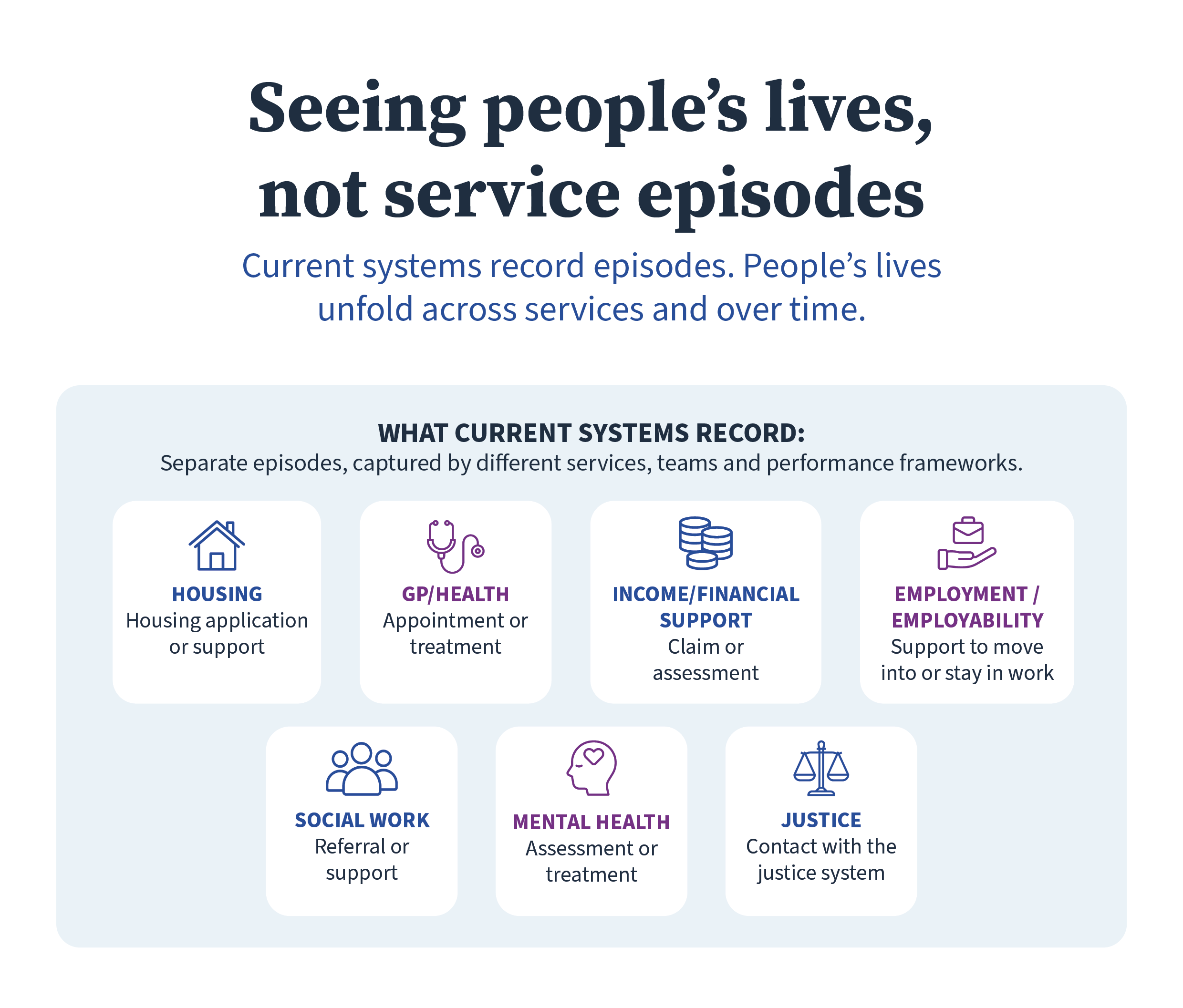
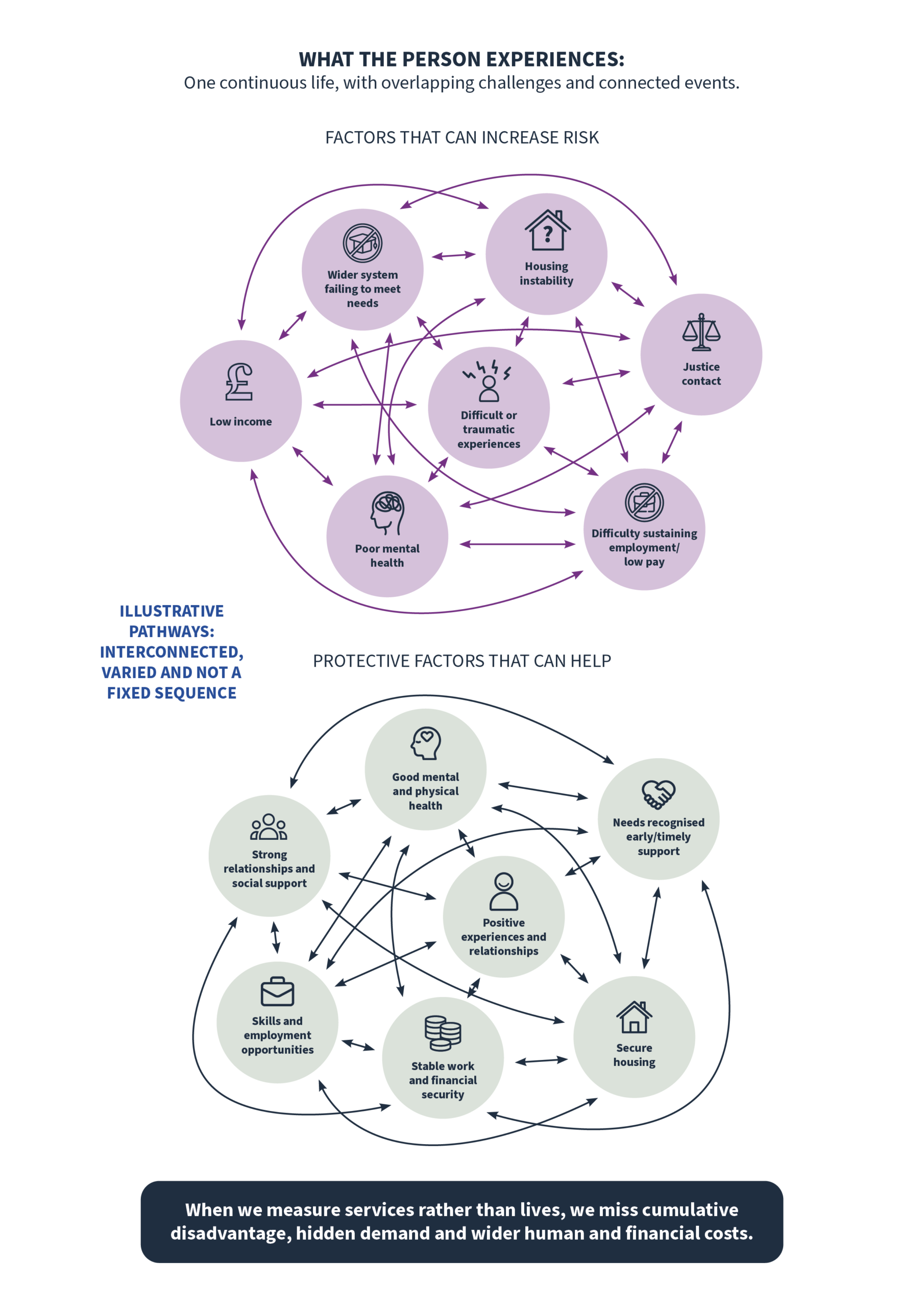
This life-course perspective was particularly evident in discussions about young adult men. Rather than describing isolated problems, practitioners traced pathways linking disrupted childhood experiences, unmet additional support needs, school disengagement, unstable housing, poor mental health, insecure employment, justice involvement and social isolation. Participants argued that these trajectories were widely recognised by those working alongside people and communities but remained much less visible within routine data or organisational performance systems. As one participant reflected:
“These young people don’t suddenly become complex at sixteen. The signs were all there.”
Participants also described the cumulative impact of people’s interactions with public services themselves. Early experiences of policing, social work, housing or other statutory services could shape trust many years later, influencing whether people sought support early or only once circumstances had become much more severe. Service churn, repeated reassessment and interrupted support were all described as gradually eroding confidence in public services and making later engagement more difficult.
Several participants suggested that current systems often required people to demonstrate stability before becoming eligible for support, despite recognising that system design itself could contribute to instability. These cumulative consequences were rarely captured within existing measures of performance but were seen as central to understanding why inequalities persist.
The discussions around homelessness illustrated this particularly clearly. Participants described routine data as capturing those who had reached statutory thresholds while providing much less visibility of the much larger population living precariously (e.g. through sofa surfing, unstable housing arrangements or repeated movement between family and friends). One participant captured this vividly:
“The issue is like an iceberg, so much of it is unseen and our role is to hack off ice cubes.”
Participants also questioned whether current approaches to measurement, budgeting and performance management mirror the same organisational logic. Costs are generally attributed to individual services, while many of the benefits of prevention, and many of the costs of failing to prevent poor outcomes, accrue across organisational boundaries and over much longer periods. This made it difficult, participants argued, to demonstrate the value of prevention, despite widespread agreement that earlier intervention would improve outcomes and reduce future demand.
Similarly, practitioners questioned whether current implementation systems adequately recognised the resources devoted to evidencing eligibility and administering conditionality. Considerable staff time was spent demonstrating that people met funding or service criteria, yet these implementation costs were rarely measured or considered alongside the wider benefits of more flexible approaches.
One participant surmised:
“[We are collectively] spending a fortune on helping people access what they are entitled to.”
Across several Action Learning Sets, participants also argued that Scotland lacks sufficiently robust evidence about the costs of not preventing problems. While the costs of crisis services are visible, the cumulative financial and human costs of delayed intervention, repeated service churn and worsening inequalities remain much harder to quantify:
“There’s a strong case for prevention, but we don’t routinely evidence the cost of not doing it.”
The justice system was frequently cited as an example of where these cumulative costs eventually become visible:
“Justice becomes the container for everything else that’s gone wrong.”
Participants argued that by the time people reach prison, homelessness services or emergency health care, many opportunities for earlier intervention have already been missed. Yet existing data and budgeting arrangements rarely illuminate the sequence of implementation decisions and missed opportunities that contributed to these outcomes.
Participants also cautioned against assuming that organisational efficiencies automatically improve implementation. Co-locating services, for example, could strengthen collaboration but could also unintentionally reduce accessibility where locations were unsuitable or inaccessible for some groups. This reinforced a broader message running throughout the Action Learning Sets: participants seemed clear that implementation should ultimately be judged by how services are experienced by the people they are intended to support, rather than solely by organisational design.
Taken together, these discussions suggest that current implementation systems illuminate some aspects of performance while leaving others largely invisible. The costs of responding to crises, delivering services and monitoring eligibility are generally visible. The cumulative harms arising from fragmented support, fractured trust, repeated service churn and delayed intervention are much less so, despite often shaping people’s lives most profoundly. Across the findings, practitioners consistently demonstrated detailed understanding of these cumulative pathways and hidden costs. Much of this implementation intelligence is not routinely captured within existing data, performance or budgeting systems, yet it represents an important resource for strengthening policy design, implementation and prevention.
Finding 6: Key implementation insights
- Practitioners consistently described people’s lives as unfolding across multiple organisations and over many years, while current implementation systems largely measure organisational episodes, service contacts and short-term outcomes.
- Participants argued that routine data, performance measures and budgeting arrangements often make visible the costs of responding to crises while obscuring the cumulative harms and longer-term costs of failing to prevent them.
- Repeated service churn, fractured trust and accumulated disadvantage were widely recognised locally but were rarely visible within existing information systems, despite shaping later demand for services.
- Participants questioned whether implementation systems currently capture the resource devoted to administering eligibility, conditionality and fragmented service delivery, or the hidden costs these processes create.
- Strengthening prevention will require data, measurement and budgeting approaches that better reflect people’s life trajectories, cumulative harms and the long-term value of earlier intervention. Participants argued that making these pathways more visible would also enable Scotland to make much better use of the implementation intelligence that already exists across its local systems.
Topic-specific implementation insights and actions
The previous section identified six implementation challenges that recurred across different places, organisations and policy contexts. This section examines how those challenges played out within the three Action Learning Set topics, preventing homelessness, supporting employability and young adult men, and highlights the actions participants and SHERU have identified in response. These actions operate at different levels. Some can be progressed by individual practitioners or organisations, others require coordinated local leadership, while some depend on changes to national policy, funding or implementation arrangements.
Participants recognised that many of the actions proposed would be challenging to implement. However, they frequently questioned whether continuing with existing arrangements was any less risky, given rising demand, worsening inequalities and growing pressures on services. Rather than advocating change for its own sake, participants emphasised the importance of creating the conditions that would enable Scotland’s longstanding preventative ambitions to become more achievable in practice.
Preventing Homelessness
The Preventing Homelessness Action Learning Sets illustrated how implementation is shaped by local housing system conditions and wider socio-economic contexts. While participants across both locations shared a strong commitment to homelessness prevention, they described markedly different starting points for implementation. In Edinburgh, discussions were dominated by the housing emergency, acute affordability pressures and severe constraints in housing supply. In North Lanarkshire, participants highlighted different contextual challenges, including patterns of socio-economic disadvantage and the nature of the local housing stock.
These discussions demonstrated that the implementation challenge cannot be understood through policy design alone. The capacity to realise preventative ambitions depended on the interaction of local housing markets, housing supply, demographic characteristics, service demand and the wider resource environment. As a result, similar national ambitions encountered different opportunities and constraints in different places, highlighting the importance of implementation approaches that are sensitive to local context.
The preventing homelessness sets were both marked by the immediacy and inescapability of the housing emergency, especially in Edinburgh (which was one of the first local areas to declare a housing emergency, back in November 2023). Participants worked within contexts where statutory duties, supply constraints and public scrutiny converged to produce intense crisis orientation. Participants’ reflections captured both the urgency of the housing emergency and the wider implementation questions it raised:
“This really made me think – who is accountable for homelessness in public health and other anchor institutions?”
“Are we solving a problem without knowing the extent of it?”
“How do we change the culture at a higher level so we can unshackle to structure”
Participants also reflected that prevention sometimes required difficult conversations. Being honest with people about housing constraints, while continuing to support them, was seen as preferable to creating unrealistic expectations that ultimately undermined trust.
Another common reflection in the preventing homelessness discussions was the importance of the relationship between system pressures and organisational capacity, with participants frequently questioning whether existing arrangements were sufficiently aligned to support a preventative approach. Several implementation challenges were particularly evident:
- Housing supply shapes what prevention can achieve: Participants consistently identified housing supply as a critical system constraint. The availability of suitable housing was viewed as a foundational condition for prevention, limiting the extent to which preventative ambitions could be realised through existing policy and service interventions alone.
- Supporting the workforce is part of prevention: Participants described the human impact of working within systems where levels of need routinely exceed available capacity. Reflections highlighted the importance of workforce wellbeing, organisational resilience and sustainable operating models as factors influencing the ability of services to maintain a long-term preventative focus.
- Transitions create opportunities for prevention and risks when systems fail to connect: Key life transitions, including prison release, hospital discharge and relationship breakdown, were frequently identified as points at which individuals become vulnerable to homelessness. Participants emphasised that these transitions often cut across organisational boundaries, highlighting the need for stronger coordination between housing, health, justice and other public services to support effective prevention.
- Implementation depends on decisions across multiple levels of government: Participants highlighted the complexity created by the interaction of devolved and reserved policy responsibilities. There was a view that implementation outcomes can be influenced by policy decisions and governance arrangements operating across different levels of government, underscoring the importance of greater policy coherence and alignment in areas with significant implications for homelessness prevention.
Overall, these discussions suggest that preventing homelessness depends on much more than housing policy alone. Participants described prevention as requiring coordinated action across housing, health, justice and other public services, alongside sufficient housing supply to make early intervention meaningful. The findings therefore reinforce the wider argument of this report: ambitious preventative policies require implementation conditions that make those ambitions achievable within different local contexts.
Actions participants committed to
Participants identified practical steps they could take within their own roles, including:
- Building and sustaining relationships across organisations to strengthen prevention pathways, particularly when people are transitioning (e.g. hospital discharge, prison liberation and relationship breakdown).
- Creating or protecting spaces for reflective practice and peer support to mitigate moral injury and sustain relational work.
- Improving cross-service communication at individual level, particularly between housing, justice, health and third sector partners.
These actions focused on increasing relational continuity, surfacing risk earlier and challenging siloed practice within existing constraints.
Actions for local system leaders
Participants emphasised that local leadership is critical in creating conditions for prevention. Priorities included:
- Establish clear system ownership of prevention, including named senior accountability for cross-system homelessness prevention.
- Create opportunities for implementation learning across organisations, including ideas for collaborative approaches that will benefit at risk populations.
- Protect capacity for early intervention, including commissioning models that do not rely solely on crisis thresholds.
- Align housing, health and justice pathways, with a focus on transition points (e.g. hospital discharge and prison release), with clear accountability.
- Invest in workforce wellbeing, support and stability, recognising moral injury as a system risk.
- Develop and use local data to make visible churn, repeat presentations, cross-system trajectories, hidden homelessness and the cost of remaining responsive, rather than preventative.
These actions reflect the need for leadership to shift systems from reactive coordination to proactive prevention.
Actions at national level
Participants consistently located several constraints at national policy and funding level, including:
- Strengthen national leadership of prevention as a system outcome that will be monitored and rewarded across services.
- Review how funding, targets and scrutiny frameworks incentivise fragmented systems and crisis responses, rather than sustainable joined-up action, and shift from multiple siloed performance indicators towards fewer, collaborative performance indicators.
- Support local systems to build housing supply.
- Improve national data and evidence on repeat homelessness, system churn and on the resulting harms and public service costs.
- Collaborate with local areas to create space for place-based prevention innovation, while systematically identifying, evaluating and sharing learning from successful pilots and local innovations with the potential to be adapted and scaled across Scotland.
Employability
The Employability Action Learning Sets highlighted a fundamental tension between how employability policy is often designed and how practitioners experience implementation in practice. National ambitions frequently assume the focus for practitioners should be identifying pathways into work and supporting people to progress with these pathways. Participants, by contrast, described supporting people whose lives were shaped by interacting challenges relating to housing, physical and mental health, caring responsibilities, trauma, poverty and involvement with the justice system. As with homelessness, early life adversity was often acknowledged as a factor.
Across both areas, participants reframed employability as a system-wide challenge rather than solely a labour market intervention. Individuals seeking support were often simultaneously engaging with health, housing, social care, justice and welfare systems, meaning that progress towards employment was frequently influenced by factors beyond the remit of employability services alone.
Several participants reflected that employability practitioners were increasingly addressing housing insecurity, mental health, trauma and financial crises because these issues often had to be stabilised before employment became a realistic goal. This reinforced the view that employability services were often being asked to respond to challenges rooted elsewhere in the system, highlighting the importance of stronger collaboration across policy areas and more integrated approaches to prevention.
Distinctive features included:
- Performance measures shape behaviour: Performance frameworks prioritised job entry, while practitioners worked with people experiencing long-term trauma, chronic instability and ill‑health, who often moved in and out of work. Prevention for these groups is likely to require much more intensive collaboration across services, may require extended support, and might warrant a more flexible approach to measuring ‘success’.
- People furthest from work risk being ‘filtered out’: One consequence of the above misalignment was that service providers felt incentivised to privilege those closest to work, who were most likely to contribute to positive performance assessment. This unintentionally exacerbates the exclusion of those furthest away from job entry, who are often those most in need of support and who are at greatest risk of pinballing between high-cost services.
- Job entry is not the same as long-term stability: Participants questioned whether implementation was being judged too heavily by job entry rather than by people’s longer-term stability and wellbeing. For some, movement into employment represented an important first step. For others, insecure, poor-quality or short-term work could reinforce instability unless accompanied by wider support.
More broadly, participants questioned whether implementation approaches sufficiently reflect the interconnected nature of the challenges faced by many individuals furthest from the labour market. Discussions suggested that employability outcomes are frequently shaped by wider determinants, including housing security, physical and mental health, caring responsibilities, transport, financial wellbeing and interactions with the justice system. Consequently, there was a strong view that narrowing the implementation gap requires greater alignment across policy areas and services, alongside a shift towards more person-centred and preventative models of support.
Taken together, these discussions suggest that the implementation challenge facing employability services is less about encouraging more people into employment than about creating systems capable of supporting complex and often non-linear journeys towards stable work. Current performance frameworks, funding arrangements and organisational boundaries did not always reflect these realities, limiting the extent to which employability services could contribute to Scotland’s wider preventative ambitions.
Actions participants committed to
Within their own roles, participants identified actions including:
- Reframing employability conversations to focus on stability, health and confidence, not only job entry.
- Building stronger informal relationships with health, housing and justice partners to improve joint working around complex lives.
- Challenging deficit-based narratives and supporting non-linear pathways for participants.
- Advocating more explicitly within organisations for flexible delivery models and reflective practice.
- These actions aimed to increase honesty about system limits, strengthen relational working and resist narrow success measures.
Actions for local system leaders
Participants highlighted the need for senior leadership to:
- Work with local communities and frontline service providers to co-design employability pathways to reflect non-linear lives, with flexible engagement, re-entry and support continuity.
- Align employability more closely with mental health, housing and trauma services.
- Review local performance frameworks to ensure they do not exclude those with the highest need.
- Invest in workforce capability, including trauma-informed approaches, supervision and protected reflective space.
- Use local data to understand who is filtered out, who disengages and why.
These actions focus on achieving greater prevention by making employability support models more inclusive and able to flex to the non-linear realities of some people’s lives.
Actions at national level
Participants emphasised the role of national policy in shaping employability practice:
- Review how No One Left Behind and other national employability frameworks are operationalised, ensuring that funding, outcomes and performance measures support the wider preventative ambitions of the strategy rather than encouraging narrower definitions of success.
- Support integration between employability, health and justice policy, including by developing better evidence of the links between these areas, including in terms of the costs to the public purse.
- Improve national data on repeat programme entry, the impacts of sanctions and the long-term trajectories of service users (especially those facing multiple challenges).
- Create space within national programmes for locally defined prevention and engagement models and creating national spaces to learn from local innovation.
Young Adult Men (18-44)
The Action Learning Sets focusing on young adult men asked a different question from the housing and employability discussions. Rather than exploring the implementation of a particular policy area, they examined what becomes visible when implementation is viewed through the experiences of a population at particularly high risk of premature mortality, homelessness, justice involvement and multiple disadvantage. Participants consistently argued that young adult men were highly visible once people reached crisis, but much less visible within preventative policy and service design.
Participants argued that adopting a population lens revealed implementation issues that were less visible when services or policies were considered separately. Looking across housing, health, justice and employability together exposed patterns of cumulative disadvantage, fragmented responsibility and missed opportunities for prevention that might otherwise remain hidden.
Across both local areas, participants described young adult men’s lives as spanning housing, health, justice, employability, substance use and community services. They questioned whether systems organised around individual organisations and policy areas could provide coherent preventative support for a population whose needs routinely crossed organisational and policy boundaries. Key transition points, including prison release, changes in housing status and movement between services, were repeatedly identified as opportunities whereby earlier, better coordinated intervention could alter life trajectories. Participants also reflected on wider blind spots, including whether the workforce consistently reflected or understood the experiences of the population it was seeking to support. For example:
“You start to see how often we’re all responding to the same crisis from different angles, without ever joining it up.”
“We act surprised when they disengage, but we design systems that push them out”
Participants frequently referred to Housing First as an example of a rights-based, prevention-oriented model that demonstrates what can be achieved when long-term relationships and flexible support are designed into implementation. At the same time, they emphasised that even successful models require continued adaptation to local circumstances and cannot, on their own, address the wider fragmentation of systems. Embedding preventative thinking across transitions and throughout wider service pathways was therefore seen as essential for reducing predictable harms and strengthening long-term outcomes.
Dynamics extended beyond housing. In men’s ALSs, participants linked the relative policy invisibility of young adult men to stereotypes and social norms:
“Some behaviours are seen as ‘understandable’ in other groups…in young men they’re seen as dangerous.”
“We have a weird societal norm that men have to just get on with it.”
Participants noted that the sensitive nature of discussions, regarding complex life courses including trauma, suicide, violence, substance use, justice involvement, and disengagement, all required a space where uncertainty and discomfort could be voiced openly as well as new understandings to be built. Multi agency working was vital to support understandings and infrastructure and connections across different pathways and trajectories in the justice sphere with other policy areas.
Opportunities for better upstream prevention were highlighted by action learning participants around prison discharges in terms of building better and more consistent and tailored liaison across Scotland to housing services, as well as opportunities to work differently within court systems and intervene in more preventative ways.
Participants acknowledged the considerable complexity of the implementation landscape, noting that local practice is shaped not only by organisational factors but also by wider national decisions and system‑level pressures. For example, national level policies on early release can create sudden increases in demand for housing and support, placing additional strain on services already operating within constrained capacity. These pressures intersect with broader challenges across Scotland’s housing system, including limited supply, high demand, and competing policy priorities. As a result, even well‑intentioned national policy commitments can be difficult to operationalise consistently, with frontline practitioners often required to navigate tensions between strategic expectations and the practical realities of limited resources and structural constraints.
It was also noted that effective justice‑related work, particularly in responding to serious and organised crime, depends on securing broader community awareness and engagement. They noted that meaningful progress in this area requires not only coordinated action across statutory services but also sustained community buy‑in, as local trust, cooperation and shared understanding are critical for disrupting harmful networks and supporting safer environments. This was seen as an essential, yet often under‑developed, component of long‑term prevention and resilience‑building efforts and dependent on appropriate resource flows and relational work to do this effectively.
Distinctive features included:
- Young adult men were highly visible within crisis systems but much less visible within prevention strategies: Participants repeatedly described young adult men as highly visible in crisis systems but largely absent from prevention frameworks.
Fragmented ownership: Responsibility for engagement, early intervention and long‑term outcomes among this population group was described as especially diffused across distinct systems. Repeated loss of support at service boundaries was identified as a primary driver of harm.
Masculinity and service design: Participants questioned whether services consistently recognised the ways men may express distress or seek help, contributing to missed opportunities for earlier intervention.
Justice as default pathway: Justice services were frequently described as absorbing unmet need originating elsewhere in the system, reinforcing participants’ view that prevention requires much stronger alignment between justice, housing, health and employability.
Taken together, these discussions suggest that young adult men represent an important test case for Scotland’s preventative ambitions. Participants described a population whose needs routinely crossed organisational and policy boundaries, yet whose experiences were rarely considered collectively. They argued that greater coherence across policy frameworks, clearer ownership and stronger attention to key transition points could create more opportunities for prevention before crises become entrenched.
Actions participants committed to
Participants working directly with men identified actions including:
- Developing earlier, informal points of contact, including outreach and relationship-based engagement.
- Using individual roles to improve people’s experiences of transitioning between services, e.g. when men are released from prison.
- Strengthening reflective practice focused on masculinity, trauma and help-seeking, and challenge gendered assumptions within services and partnerships.
- Working more explicitly to focus on men aged 18-25
- These actions centred on changing practice culture and relational approaches within existing services.
Actions for local system leaders
Participants argued that local leaders must:
- Improve cross-system coordination across housing, justice, mental health and employability, including by hosting shared developmental days and working with these services to develop collaborative performance indicators.
- Use population-level approaches, including an explicit focus on men aged 18–44, to identify where needs, risks and opportunities for prevention span organisational and policy boundaries, with clear local ownership for coordinating action.
- Use data to map pathways into crisis for young adult men, not only service volumes.
- These actions seek to move young adult men from residual crisis populations to visible prevention priorities.
Actions at national level
Participants consistently located the policy ‘blind spot’ that SHERU identified at national level [7]:
- Explicitly recognise men aged 18–44 with risk factors for premature mortality (deaths from alcohol, suicide and drugs), while encouraging greater use of population-based approaches to identify implementation challenges that cut across policy and organisational boundaries.
- Strengthen national evidence on the experiences of men at risk of deaths associated with drugs, alcohol and suicide (sometimes collectively described as ‘deaths of despair’ [64]) to better understand their trajectories and potential points for system intervention.
- Review how justice and policing, housing and employability policies intersect for young adult men.
- Ensure national monitoring frameworks capture cumulative disadvantage and transition failure (both of which were identified as particularly impacting on young adult men).
From Implementation Learning to Local Action
Alongside generating the findings reported here, the Action Learning Sets supported participants to identify actions within their organisations and local systems. We continued working with several participants between and beyond the sets as they sought to develop these ideas. This experience highlighted the time involved in preventative work and the relationships, resources and organisational support needed to carry it forward.
The learning informed improvements to existing programmes, new roles and pilots, proposals for investment and connections around shared problems. The contribution of the Action Learning Sets varied: some changes arose directly from set discussions, while others were already being considered and were informed or accelerated by the process. The examples below describe the changes known to SHERU at the time of writing and the contribution made by the Action Learning Sets.
Case Study 1: Co-locating Employment Support for Prevention (Edinburgh)
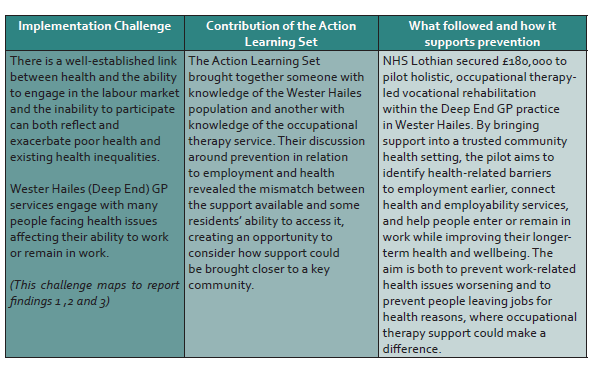
Case Study 2: Embedding Workforce Wellbeing Within Housing Services (Edinburgh)
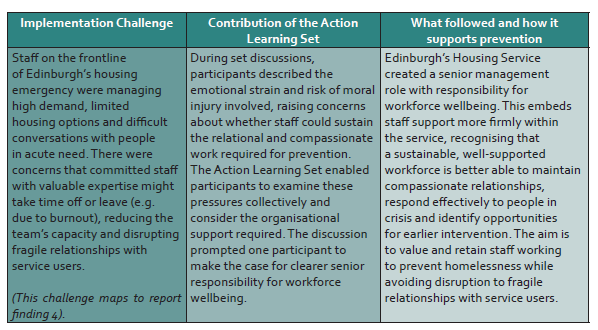
Case Study 3: Creating Space for Learning to Improve Service Delivery (Edinburgh)
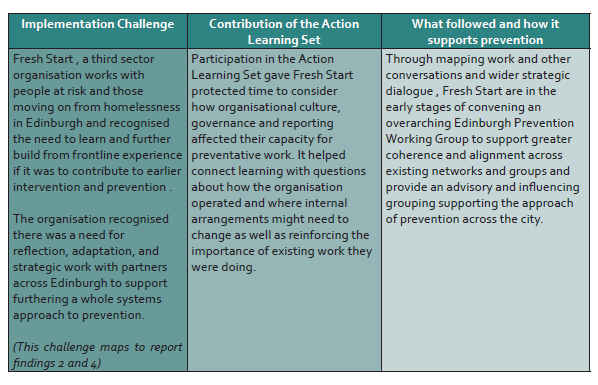
Case Study 4: Building Prevention into Everyday Housing Practice (North Lanarkshire)
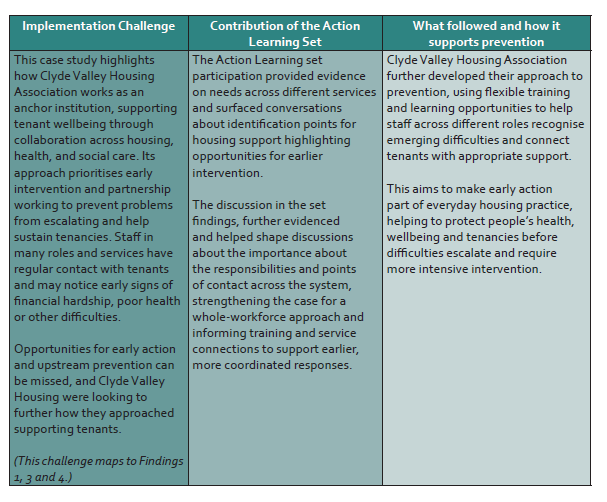
Case Study 5: Developing a Coordinated Response to Single Adults’ Housing and Support Needs (North Lanarkshire)
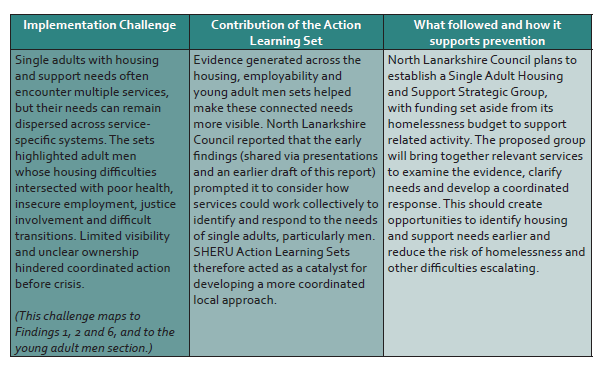
Case Study 6: Using Action Learning Sets to Develop NL Reach – an Ask and Act Homelessness Prevention Pilot (North Lanarkshire)
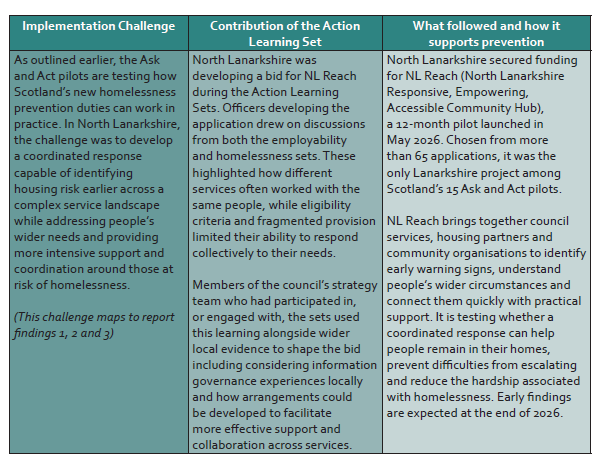
Case Study 7: Using Action Learning Sets to Consider and Pivot During a Shifting Landscape (Business Gateway Lanarkshire)
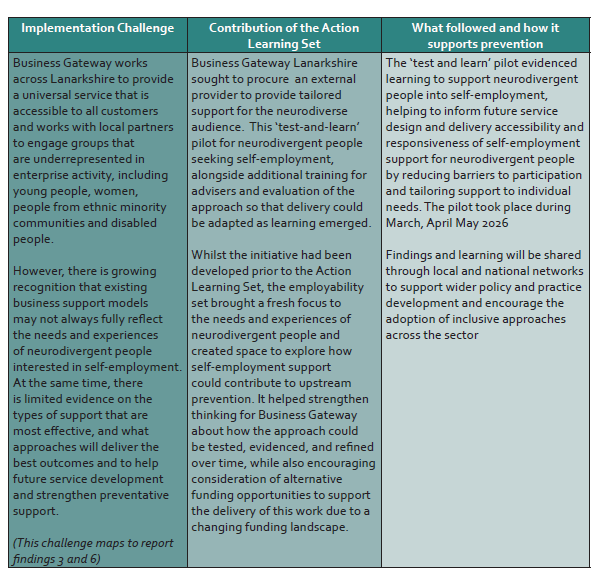
How the learning is being taken forward in each area
The case studies above describe several ways in which the Action Learning Sets contributed to local change. The strength and nature of that contribution varied: some actions emerged directly from set discussions, while others drew on the findings alongside existing evidence and work already under way. Further uses of the learning are also planned within both local authorities.
Edinburgh
As noted earlier, Edinburgh had already established cross-sector relationships and a strong commitment to partnership working. Right from the start, senior discussions brought together council staff, NHS Lothian, Capital City Partnership and third sector organisations, such as Cyrenians. This provided a foundation for coordinated work across services. During the research period, the Edinburgh Partnership strengthened its focus on prevention through the development of shared terminology, a prevention workplan and a Prevention Board [65]. The city’s partnership capacity was also evident in its successful Ask and Act pilot application, a System Wide Approach to Prevention (SWAP), in Wester Hailes. This brings together the council, NHS Lothian, Police Scotland, housing, social security, prisons and third sector partners. These developments progressed independently of SHERU but provided a receptive context in which the learning from the sets could be taken forward.
In Edinburgh, the Action Learning Sets contributed to several practical developments described in the case studies above. Discussions about barriers to employment support helped bring together knowledge held by Deep End GP practices and occupational therapy services, contributing to the development of a £180,000 pilot providing vocational rehabilitation within a GP practice in Wester Hailes. Within Edinburgh’s Housing Service, reflection on the pressures facing frontline staff prompted a participant to initiate a senior management role with explicit responsibility for workforce wellbeing. These examples show the learning informing both service development and the organisational conditions needed to sustain preventative work.
Edinburgh council leaders also took steps to ensure key learning reached a wider audience across the council. Following a presentation from SHERU about the early insights, we were invited to give the keynote address at Leading Differently for Health Equity: Learning from Action Learning Sets, an Edinburgh Council event attended by around 200 staff. The presentation shared findings from the sets and invited staff from across the council to consider their implications for leadership, collaboration and prevention. This provides evidence of wider engagement with the learning across Edinburgh.
North Lanarkshire
The Action Learning Sets took place within a council that already had a strong commitment to integrated services, prevention and whole-family support through the Programme of Work supporting the Plan for North Lanarkshire [54].
During the research, a refresh of this programme identified Preventative Public Services as a priority [66] while prevention was also reflected in the Health and Social Care Partnership’s new Strategic Commissioning Plan [67]. North Lanarkshire’s role as an early-adopter area, working with the Scottish Government on more integrated approaches to policy delivery, funding and reporting, provides a further context for taking the learning forward. These developments progressed in parallel with the SHERU work.
The clearest contributions from the Action Learning Sets are described in the case studies above. Discussions across the employability and homelessness sets informed the development of North Lanarkshire’s successful bid for the NL Reach Ask and Act pilot. An earlier draft of this report also prompted plans for a strategic group focused on the housing and support needs of single adults, particularly men, with resources identified from the council’s homelessness budget.
Emerging messages from the research were also used alongside wider local evidence to support Community Planning Partnership backing for a more integrated approach to investing in prevention, accompanied by additional joint resources [68]. The findings are expected to inform a planned review of Employability Services and Support and discussions about more intensive, multidisciplinary support for people involved in community justice who face risks including custody and homelessness. Their relevance to North Lanarkshire’s existing trauma-informed and relationship-based work has also been recognised locally. These planned uses will provide further opportunities to assess how the learning influences policy and practice. While these developments were already underway, the Action Learning Sets have helped to strengthen the evidence base, bring together perspectives from across services, and provide additional insight to inform how preventative and integrated approaches are progressed. As these activities continue to develop, they will provide further opportunities to assess and surface how the learning influences policy, practice, implementation support for the workforce and partnership working going forward.
Conclusions and Implications for Policy and Practice
This report sets out to understand why Scotland’s longstanding commitment to prevention has proved so difficult to realise and sustain. Across six Action Learning Sets in Edinburgh and North Lanarkshire, people from a range of sectors working on preventing homelessness, supporting employability and providing services for young adult men described how preventative ambitions encounter complex and pressured local systems.
Participants strongly supported prevention, early intervention and person-centred working. However, their accounts showed how rising demand, housing shortages, workforce pressures and statutory responsibilities repeatedly pulled services towards crisis response. Funding arrangements, accountability systems and performance assessment often made collaboration harder, even where services worked with the same people and shared similar aims. Thresholds and conditionality were being used to help organisations manage scarce resources but the consequence was that support was often delayed and some people, often those facing the greatest difficulties, are ‘filtered out’ of support systems. Staff were left managing the emotional consequences of these constraints, while public narratives, political pressures and fragmented data shaped what organisations seemed able to do. Participants felt that existing data systems were more likely to capture separate episodes of service activity than people’s trajectories across services and over time. This means some of the evidence needed to make the business case for prevention is too often missing.
These influences interact and reinforce one another. Workforce pressures reduce opportunities for collaboration and reflection; fragmented accountability encourages services to protect their own capacity; and thresholds delay intervention, particularly for people facing the greatest difficulties. Existing data systems then make the cumulative harms and cross-system costs difficult to see. Together, these conditions help explain why longstanding support for prevention has not produced change on the scale envisaged.
How prevention was understood in practice
The findings also shed light on what prevention means in local implementation settings. Participants commonly described it as joined up working that identifies difficulties and provides support before people reach crisis. This includes recognising housing risk before homelessness occurs, addressing health-related barriers before people lose or disengage from employment, and reaching people whose difficulties might otherwise lead to acute ill health, custody or the loss of a tenancy. This kind of earlier intervention can improve people’s experiences and prevent some human and financial costs.
These actions broadly reflect the primary, secondary and tertiary conception of prevention identified by McNulty [27] with much of the activity sitting towards the secondary and tertiary end of that framework. They are valuable but unlikely, on their own, to produce the substantial reduction in demand and public expenditure envisaged by the Christie Commission [3] . Participants nevertheless had clear ideas about what a more substantial shift would require.
In practice, the two conceptions identified by McNulty [27] may therefore be understood as positions on a spectrum. At one end, services can make progress by intervening earlier and coordinating existing support more effectively. Further along the spectrum lies the structural transformation envisaged by Christie [3], including action on underlying inequalities, the redistribution of resources towards prevention, community empowerment and changes to how public services are organised and held accountable. Moving further along this spectrum will require local and national leaders to act on the implementation intelligence held within local systems.
The breadth of meanings attached to prevention contributes to its appeal while also complicating implementation. Agreement on the general ambition may conceal different assumptions about the changes being sought, which activities count as preventative and where responsibility and resources should sit. Scotland does not necessarily need a single definition to cover every setting, but it does need greater clarity about the outcomes being pursued, the balance sought between earlier intervention and structural change, who is responsible for these distinct prevention ambitions, and the conditions that each requires.
What this work has contributed
The Action Learning Sets brought together ‘implementation intelligence’ that was otherwise dispersed across organisations, services and professional roles. We use this term to describe the practical and contextual knowledge held by people involved in delivering and managing policies and services: knowledge of how different policies interact, where implementation becomes difficult, what unintended consequences arise and which adaptations may be viable.
Looking across local systems enabled participants to identify patterns, consequences and opportunities that were difficult to see from within individual services. Examining services from the perspective of young adult men who use services also revealed cumulative disadvantage and missed opportunities that remained less visible through policy or service-specific analysis. The findings further demonstrate that public narratives form part of the implementation environment, influencing trust, organisational risk and the space available for preventative action.
The Christie Commission described frontline staff, alongside people and communities, as well placed to improve services and recommended greater staff involvement and empowerment in service design [3]. Building on this argument, this report highlights the implementation intelligence that can be surfaced by bringing together people from different services and organisational levels within local areas. Realising prevention ambitions is likely to require the Scottish Government and local leaders to make systematic use of this intelligence in policy design, implementation planning, performance management, and ongoing learning and adaptation.
Action Learning proved valuable both as a research method and as a means of supporting local change. The facilitated sets gave participants protected space to examine live challenges, test assumptions and consider what could be changed within their organisations and partnerships.
The contribution to subsequent action varied. In Edinburgh, discussions helped develop an occupational therapy-led vocational rehabilitation pilot within a Deep End GP practice in Wester Hailes and prompted the creation of senior responsibility for workforce wellbeing within the Housing Service. The broader insights were subsequently shared with around 200 council staff through the Leading Differently for Health Equity event and senior leaders are considering how they might build on this work. In North Lanarkshire, discussions across the employability and homelessness sets informed the successful NL Reach Ask and Act bid. An earlier draft of this report also prompted plans for a strategic group focused on single adults’ housing and support needs, with resources identified from the homelessness budget. Emerging findings were used alongside wider local evidence to support Community Planning Partnership investment in prevention and are expected to inform further reviews and service discussions.
These developments remain at different stages, and their outcomes cannot yet be assessed. Some arose directly from the sets, while others were informed or accelerated by them. Together, they illustrate the practical changes to which this form of collective implementation learning can contribute.
Community knowledge and the next stage of SHERU’s work
Christie placed people and communities at the centre of public-service reform and called for their involvement in designing and delivering services [3]. We support this ambition. Community knowledge and implementation intelligence are complementary: people can explain how policies and services are experienced in their lives and describe the changes they would like to see, while practitioners and local partners can identify how those experiences are produced through the interaction of policies, resources, organisational arrangements and professional practice, and what might enable sought-after changes. Effective policy co-design needs to draw on both.
This report is limited by the absence of direct evidence from community members and people using services. Participants often discussed people’s experiences but professional accounts cannot substitute for hearing directly from those affected. SHERU has therefore been working with the Poverty Alliance and the Scottish Community Development Centre on peer research with four community groups: two in Edinburgh and two in North Lanarkshire. In each area, one group focuses on families with young children living on low incomes and another on men aged 18–44. Reports from this work will be published over the coming months. Both local areas have expressed interest in the findings, and we are currently facilitating meetings to enable the community peer-researchers to share their findings with key services in each area with reports forthcoming later in 2026.
Bringing these forms of knowledge together has real potential provide a stronger basis for the co-design of policy and implementation. Acting on what they reveal will require decisions by local leaders and national policymakers, alongside action within services and communities.
Scottish Government policy distinguishes between national policymaking and delivery by local authorities, public bodies and other partners[36]. Currently, this seems to contribute to a policy design process that operates as a largely one-way pipeline, as illustrated in Figure 3. Consultation and stakeholder engagement usually inform early development, after which national government draws the contributions together and determines the policy, funding and performance arrangements within which local bodies are expected to deliver. Opportunities for implementation experience to reshape these arrangements can then be limited or intermittent. This creates a disconnect between national ambitions and local realities, even though national decisions continue to shape many of the conditions for implementation.
The 2025 Public Service Reform Strategy recognises that frontline staff are often best placed to identify service improvements and commits to enabling them to bring forward ideas [36]. It is less clear how insights generated through implementation will be brought together across services or used to shape national policy, funding and performance arrangements. The findings in this report visualises the contrast between existing ways of working and our proposed way forward, in which implementation intelligence is usd to support better policy design, implementation, learning and adaption.
Our proposed alternative, a learning loop (Figure 3), would retain retain local ownership of delivery while creating sustained ways for community knowledge, implementation intelligence, research and national policy expertise to shape design, implementation and adaptation. It would make implementation a shared and continuing process of learning across national and local levels. The Figure 3 Policy Pipeline and Learning Loop illustrates a visualisation of this model sharing how implementation intelligence could be used to support better policy design and implementation.
Figure 3: Policy Pipeline to Learning Loop
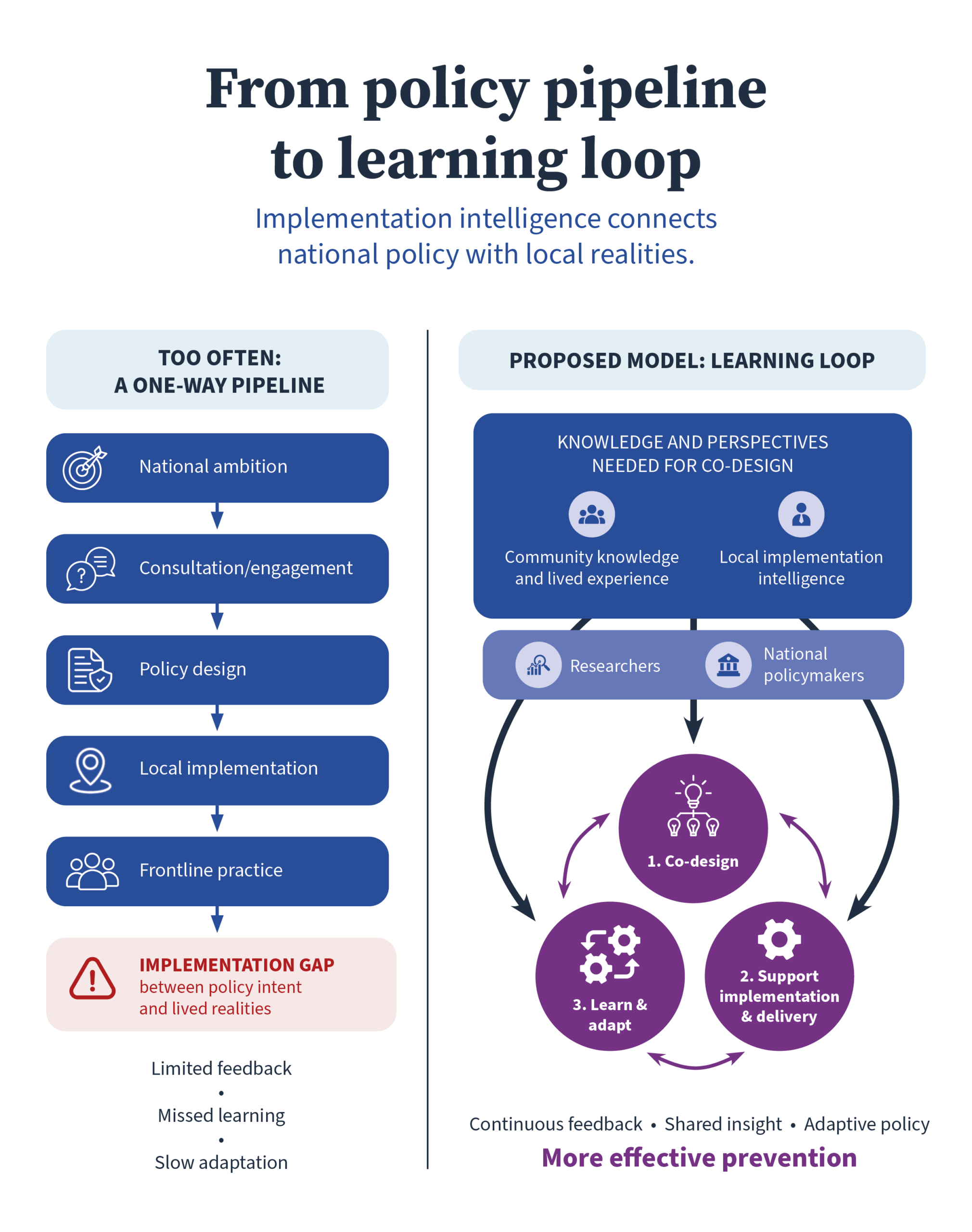
A timely opportunity for Scotland to move towards prevention
The five-year Programme for Government, Ambitious for Scotland, renews Scotland’s commitment to prevention within a longer-term framework [1]. Its duration may provide greater continuity between ambition, planning and delivery than successive annual programmes, particularly if funding for local areas and frontline services is aligned with this timeframe. The Population Health Framework, Public Service Reform Strategy and Health and Social Care Service Renewal Framework provide further support for earlier intervention, collaboration and more sustainable services [5, 12, 13]. The Verity House Agreement also establishes a basis for partnership between national and local government [37].
The Programme for Government proposes substantial organisational reform, including replacing Scotland’s 14 territorial NHS boards with two Strategic Health Boards [1]. Larger organisations may create opportunities to simplify some arrangements, coordinate services across wider areas and reduce unnecessary organisational boundaries. These benefits will depend on how the changes are designed and implemented and how they connect with local government, Health and Social Care Partnerships, third sector organisations and communities and how this change in structure enables outcomes in practice and if this strengthens outcomes in practice [35]
However, previous reforms provide grounds for caution. The creation of Police Scotland and successive NHS restructurings in England show that organisational change can consume significant leadership attention, workforce time and financial resources [69, 70]. As well as potentially distracting from prevention (work which, as this report shows, is already hard to protect), organisational reforms can generate uncertainty, interrupt established relationships and weaken local knowledge or accountability. Participants in our Action Learning Sets identified these as conditions on which collaborative preventative working depends. Structural reform may support prevention if it strengthens coordination and local capability; but, a transition that absorbs resources and disrupts effective relationships could make preventative working more difficult. Achieving a meaningful shift towards prevention requires cognisance of implementation-focused policymaking, where the role of national government extends beyond setting strategic priorities to supporting the conditions in which effective implementation can happen[20, 21]. This includes enabling the policy, funding, governance and accountability environment needed to support local action, while recognising that delivering meaningful change requires sustained attention to how priorities are interpreted, operationalised and embedded in practice.
In some ways, the proposed reforms provide an immediate test of the arguments made in this report. Local leaders, practitioners, partners and communities should be involved early enough to influence the design of new organisational arrangements. Their involvement should continue through the transition, helping to drive effective implementation and ensuring that emerging implementation intelligence can identify unintended effects, protect valuable relationships and support adaptation. The five-year framework will be most useful if it creates continuity in resources and learning as well as continuity in national ambition.
Figure 4 brings together the mutually reinforcing conditions that could enable Scotland to move further towards prevention. These provide the basis for the priorities for national and local action set out below. The ladder analogy also highlights the greater uncertainty involved as we move upstream: we need to understand how different parts of the system interact, how they might move coherently from their current state towards a new one, and how the risks associated with that transition (as we move up a rung) can be balanced.
Figure 4: Turning Implementation Learning into Progress Towards Prevention
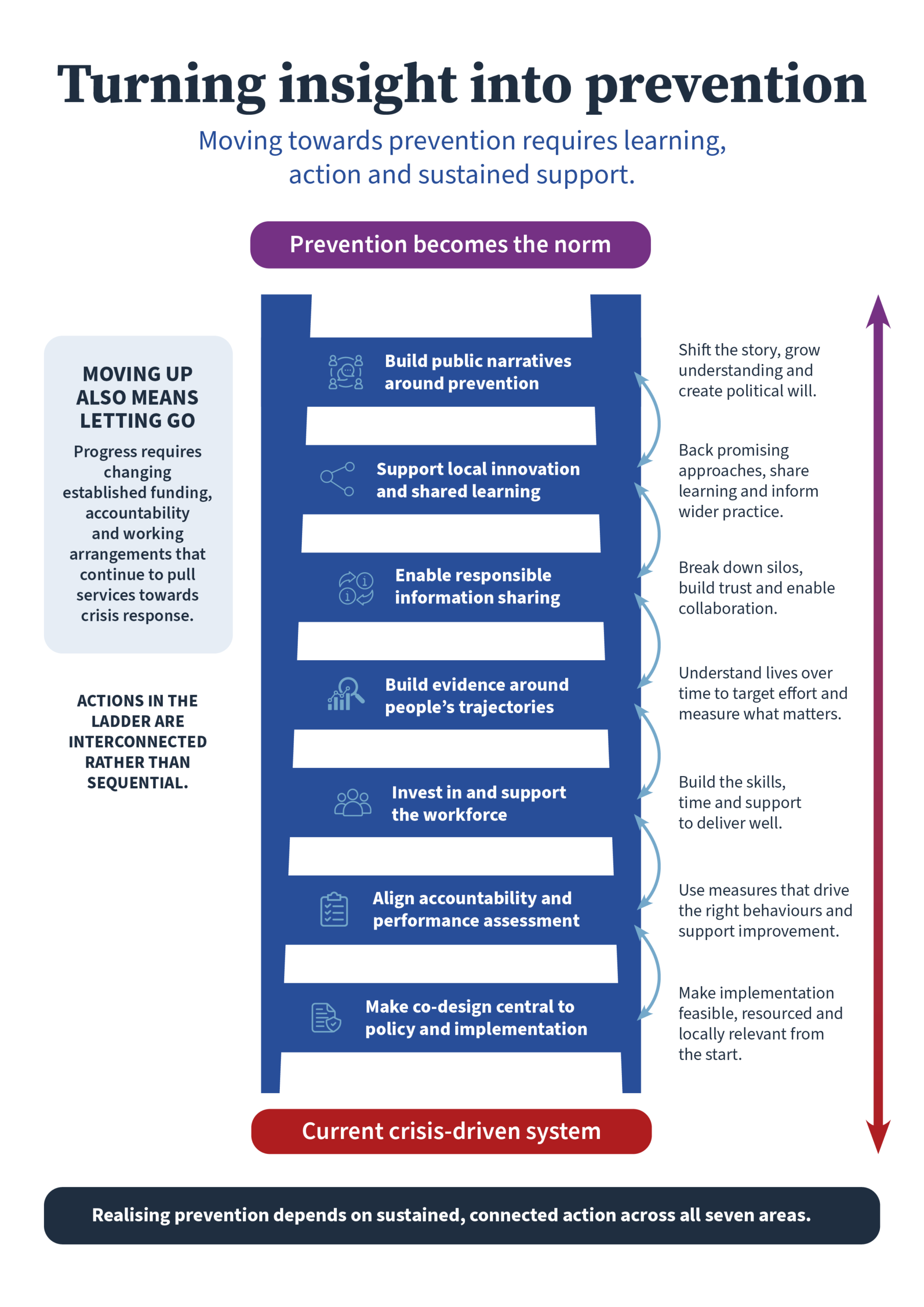
Priorities for national action
Actions national policymakers and public bodies can take
- Make co-design central to policy design and implementation: Practitioners, local leaders, third sector partners and communities should be involved early enough to shape policy choices, resources, accountability and delivery arrangements. Their involvement should continue through implementation and learning so that community knowledge and emerging implementation intelligence can inform adaptation.
- Match policy expectations with implementation capability: The cumulative demands created by new and existing commitments should be assessed alongside workforce capacity, funding and the practical consequences for local services. Longer-term and more stable funding is needed where preventative work depends on sustained relationships and learning.
- Align accountability and performance arrangements with collaboration and prevention: National requirements should support shared outcomes across services and reduce duplicative reporting. New indicators should replace requirements that have outlived their usefulness rather than adding further layers to an already crowded system.
- Provide leadership and practical support for data sharing: Clearer guidance, training and more compatible systems are needed so that proportionate information sharing can support coordinated services. Data and evaluation should also be designed to illuminate people’s trajectories across services and systems, the cumulative harms that can coalesce across the lifecourse, and the human and financial costs of delayed intervention.
- Develop sustained mechanisms for learning across Scotland: Local innovation should be accompanied by opportunities to examine how and why approaches work, adapt learning to different contexts and connect it to national policy. Communities of practice and cross-area learning networks would provide greater continuity than one-off events or webinars.
- Build public understanding of the role of prevention: National leaders should articulate a credible account of the different forms prevention can take, why earlier and more fundamental action matter and what change people can realistically expect. Misinformation, stigma and narratives that undermine trust or place vulnerable groups at risk require active responses.
Priorities for local action
Actions local leaders and partnerships can take
- Create sustained, constructively facilitated spaces for cross-system learning and co-design: These should bring together people from different services and levels of seniority, alongside third sector organisations and communities, to examine shared challenges and develop responses.
- Review how people gain access to support: Local systems should examine where thresholds, eligibility rules, referral processes and assumptions about engagement delay help or exclude people with complex lives. Where barriers arise from national requirements or insufficient resources, these should be documented and communicated clearly.
- Strengthen shared responsibility for prevention: Leaders should identify where local budgets, targets and reporting arrangements pull partners in different directions. Shared outcomes for the people and communities served can reduce dependence on individual relationships to hold collaboration together.
- Protect workforce capacity and relationships: Staff need manageable expectations, effective supervision, psychological support and time for professional judgement, relational work and reflection. Local leaders should also consider how organisational decisions affect continuity and trust between staff and communities.
- Make better use of local data, community knowledge and implementation intelligence: Services should bring together quantitative evidence, frontline experience and people’s accounts of their lives to understand journeys across systems. This combined learning should inform service adaptation, investment decisions and the case made for wider change.
- Evaluate and share local innovation: Pilots and new approaches should build in opportunities for learning from the outset, including learning about what has not worked and why. Local areas should be open about the conditions that enabled progress, the difficulties encountered and whether an approach may be suitable for adaptation elsewhere.
- Create credible local narratives about prevention: Local leaders should explain local choices, pressures and timescales transparently, while challenging stigma and misinformation circulating about local areas (including via social media) that obstruct collaboration, damage trust or community relations.
In setting out national and local priorities it is important to emphasise that national and local responsibilities are closely connected. While local leaders can change relationships, processes and organisational practices, national decisions shape the context in which they must act including the legislative environment, frameworks of accountability and much of the funding at their disposal. Stronger connectivity between these levels is necessary to help distinguish barriers that can be addressed locally from those requiring national action.
Scotland already possesses considerable expertise, commitment and creativity within its communities, local systems and frontline services. The task for the coming years is to make fuller use of these resources: creating the time, authority and mechanisms through which community knowledge and implementation intelligence can shape policy, guide implementation and support continuing learning. This would give Scotland a stronger prospect of moving along the spectrum from earlier intervention towards the deeper preventative transformation envisaged by Christie and furthering this in the policy and implementation landscape in Scotland. Looking ahead, continued policy maturation will require a stronger focus on implementation, with national government playing a key role in recognising and supporting the conditions through which prevention ambitions can be translated into practice and sustained over time as well as the outcomes that can be achieved.
References
[1] Scottish Government. Ambitious for Scotland Programme for Government 2026 to 2031. Edinburgh, https://www.gov.scot/publications/programme-government-2026-2031/ (1 September 2026, accessed 7 September 2026).
[2] Williamson V, Murphy D, Greenberg N. COVID-19 and experiences of moral injury in front-line key workers. Occup Med (Lond) 2020; 70: 317–319.
[3] Campbell C. Christie Commission on the future delivery of public services. Edinburgh, https://www.gov.scot/publications/commission-future-delivery-public-services/ (2011, accessed 9 February 2026).
[4] Gardner C, Roy G, Mitchell J. The Christie Commission 10 years on: Reflections on progress and areas for action – Policy Scotland. Policy Scotland, https://policyscotland.gla.ac.uk/the-christie-commission-10-years-reflections-on-progress/ (2021, accessed 27 July 2026).
[5] Scottish Government. Scotland’s Population Health Framework. Edinburgh, https://www.gov.scot/publications/scotlands-population-health-framework/ (17 June 2025, accessed 24 March 2026).
[6] Finch D, Wilson H, Bibby J. Leave no one behind: The state of health and health inequalities in Scotland. Epub ahead of print 17 January 2023. DOI: 10.37829/HF-2023-HL01.
[7] O’Brien A, Curtis P, Finch D. The Preventative Shift, How can we embed prevention and achieve long term missions., https://www.health.org.uk/reports-and-analysis/briefings/the-preventative-shift-how-can-we-embed-prevention-and-achieve-long (February 2025, accessed 9 February 2026).
[8] Audit Scotland. Community health and social care face unprecedented pressures and financial uncertainty, https://audit.scot/news/community-health-and-social-care-faces-unprecedented-pressures-and-financial-uncertainty (2024, accessed 21 August 2026).
[9] Public Health Scotland. Building a prevention‑focused system, https://publichealthscotland.scot/about-us/what-we-do-and-how-we-work/together-we-can-our-10-year-strategy-to-2035/how-well-deliver-our-strategy/building-a-prevention-focused-system/ (2026, accessed 21 August 2026).
[10] COSLA. A Social Care System Built on Prevention Local Government’s Call for Change, https://www.cosla.gov.uk/news/2026/april/a-social-care-system-built-on-prevention-local-governments-call-for-change (2026, accessed 21 August 2026).
[11] COSLA. COSLA calls for stronger national approach to preventing poverty, https://www.cosla.gov.uk/news/2026/april/cosla-calls-for-stronger-national-approach-to-preventing-poverty (2026, accessed 21 August 2026).
[12] Scottish Government. Health and Social Care Service Renewal Framework, https://www.gov.scot/publications/health-social-care-service-renewal-framework/ (13 June 2025, accessed 25 August 2026).
[13] Scottish Government. Scotland’s Public Service Reform Strategy: Delivering for Scotland. Edinburgh, https://www.gov.scot/publications/scotlands-public-service-reform-strategy-delivering-scotland/ (19 June 2025, accessed 10 April 2026).
[14] Boyle S. Blog: Christie 10-years on. Audit Scotland, https://audit.scot/publications/blog-christie-10-years-on (2021, accessed 21 August 2026).
[15] Audit Scotland. Scotland’s councils risk becoming financially unsustainable, https://audit.scot/news/scotlands-councils-risk-becoming-financially-unsustainable (2026, accessed 4 February 2026).
[16] Audit Scotland. NHS in Scotland 2025. Edinburgh, https://audit.scot/uploads/2025-11/nr_251204_NHS_in_Scotland_2025.pdf (December 2025, accessed 23 March 2026).
[17] The Royal Society of Edinburgh, Audit Scotland. Public service reform in Scotland: how do we turn rhetoric into reality?, https://audit.scot/uploads/2024-11/as_241126_as_rse_roundtable_public_sector_reform.pdf (2024, accessed 11 February 2026).
[18] Scottish Fiscal Commission. Fiscal Sustainability Perspectives What Scotland’s Finances Mean for the Next Parliament . Edinburgh, https://fiscalcommission.scot/wp-content/uploads/2026/02/FSP-Report-what-Scotlands-finances-mean-for-the-next-parliament-February-2026BF45GS7.pdf (February 2026, accessed 10 April 2026).
[19] Hudson B, Hunter D, Peckham S. Policy failure and the policy-implementation gap: can policy support programs help? Policy Design and Practice 2019; 2: 1–14.
[20] Lloyd A. Implementation-minded policy making Policy Briefing. Wales, https://wcpp.org.uk/wp-content/uploads/POLICY-BRIEFING-Implementation-1.pdf (2023, accessed 16 July 2026).
[21] Baan A-M, Lewis J, Wills E, et al. Implementation-minded policy making. Wales, https://wcpp.org.uk/wp-content/uploads/Implementation-Minded-Policy-Making-1.pdf (2023, accessed 16 July 2026).
[22] Smith K. Beyond Evidence Based Policy in Public Health: The Interplay of Ideas. Basingstoke : Palgrave Macmillan Ltd. Epub ahead of print 10 October 2013. DOI: 10.1057/9781137026583.
[23] Bacchi C. Analysing Policy. Pearson Higher Education, 2009.
[24] Bullock HL, Lavis JN, Wilson MG, et al. Understanding the implementation of evidence-informed policies and practices from a policy perspective: a critical interpretive synthesis. Implementation Science 2021 16:1 2021; 16: 18-.
[25] Lipsky M. Street-Level Bureaucracy, 30th Anniversary Edition: Dilemmas of Individuals in Public Service. New York: Russell Sage Foundation, 2010.
[26] Hill O’Connor C, Smith K, Hughes C, et al. Operationalizing inclusive growth: Can malleable ideas survive metricized governance? Public Adm 2024; 102: 114–130.
[27] McNulty D. Prevention in Public Service Reform : Two concepts, One word: The Christie Definition, the Public Health Model, and their Implications in the Aftermath of the 2026 Scottish Election. Edinburgh, https://media.enlighten.scot/uploads/2026/06/Prevention-in-Scottish-Public-Service-Reform.pdf (2026, accessed 24 August 2026).
[28] Peters BG, Nagel ML. From benign to malign: unintended consequences and the growth of Zombie policies. Policy Soc 2025; 44: 136–149.
[29] Barrett S, Fudge C (eds). Policy and action: Essays on the implementation of public policy. 2nd ed. London: Routledge, https://www.taylorfrancis.com/books/edit/10.4324/9781003644729/policy-action-susan-barrett-colin-fudge (2026, accessed 8 September 2026).
[30] Okasha R. Public service reform is not public sector reform. Enlighten, https://www.enlighten.scot/public-service-reform-is-not-public-sector-reform/ (2026, accessed 24 August 2026).
[31] Hupe PL, Hill MJ. ‘And the rest is implementation.’ Comparing approaches to what happens in policy processes beyond Great Expectations. Public Policy Adm 2016; 31: 103–121.
[32] Hill HC. Understanding Implementation: Street‐Level Bureaucrats’ Resources for Reform. Journal of Public Administration Research and Theory 2003; 13: 265–282.
[33] Cerna, L. (2013). The Nature of Policy Change and Implementation: A Review of Different Theoretical Approaches. https://www.luciecerna.com/uploads/5/1/2/5/5125288/the_nature_of_policy_change_and_implementation.pdf
[34] Smith EK, Jack D, McHardy F, et al. Making Prevention Real: What Public Sector Reform Needs to Deliver for Scotland – Scottish Health Equity Research Unit. Glasgow, https://scothealthequity.org/making-prevention-real/ (18 August 2026, accessed 7 September 2026).
[35] Jack D, Catalano A, Thompson S, et al. Beyond Ambition: What does Scotland’s new Programme for Government mean for health inequalities? – Scottish Health Equity Research Unit. Glasgow, https://scothealthequity.org/beyond-ambition-what-does-scotlands-new-programme-for-government-mean-for-health-inequalities (16 September 2026, accessed 16 September 2026).
[36] Scottish Government. Scotland’s Public Service Reform Strategy: Delivering for Scotland. Edinburgh, https://www.gov.scot/publications/scotlands-public-service-reform-strategy-delivering-scotland/ (19 June 2025, accessed 24 March 2026).
[37] Scottish Government. New Deal with Local Government – Verity House Agreement. Scottish Government 2023; 1–22, https://www.gov.scot/publications/new-deal-local-government-partnership-agreement/ (Accessed 22 September 2026)
[38] UK Collaborative Centre For Housing Evidence. The 2026 Scottish Election: Housing Evidence Priorities for a New Government -, https://housingevidence.ac.uk/project/the-2026-scottish-election-housing-evidence-priorities-for-a-new-government/ (2025, accessed 26 August 2026).
[39] Thompson D, Macpherson S. Policy in practice: How Scotland can get it right : Royal Society of Edinburgh, https://rse.org.uk/programme/advice-paper/policy-in-practice-how-scotland-can-get-it-right/ (2026, accessed 26 August 2026).
[40] Scottish Parliament. Meeting of the Parliament: [Draft] Meeting date: Thursday, June 11, 2026, https://www.parliament.scot/chamber-and-committees/official-report/search-what-was-said-in-parliament/recent-publication?meeting=20169&iob=223798 (2026, accessed 14 July 2026).
[41] Scottish Fiscal Commission. Fiscal Update. Edinburgh, https://fiscalcommission.scot/wp-content/uploads/2026/08/Fiscal-Update-August-2026-revised-on-25-08-2026.pdf (August 2026, accessed 25 August 2026).
[42] Marshall M. Affordable housing need in Scotland post 2026 – UK Collaborative Centre For Housing Evidence, https://housingevidence.ac.uk/affordable-housing-need-in-scotland-post-2026/ (1 October 2025, accessed 26 August 2026).
[43] Scottish Government. Just transition – Climate change – gov.scot, https://www.gov.scot/policies/climate-change/just-transition/ (accessed 26 August 2026).
[44] Scottish Procurement Alliance. Implementing the Community Wealth Building Act, https://www.scottishprocurement.scot/news-insights/implementing-the-community-wealth-building-act/ (2026, accessed 26 August 2026).
[45] Thompson S, Randolph H. Understanding the latest child poverty statistics | FAI, https://fraserofallander.org/child-poverty-stats-2026/ (2026, accessed 26 August 2026).
[46] Scottish Communities for Health and Wellbeing, Health and Social Care Alliance Scotland, Community Health Exchange. Prevention Under Pressure: The State of Community Led Health in Scotland, https://www.alliance-scotland.org.uk/blog/news/prevention-under-pressure-report-highlights-the-crisis-facing-community-led-health-in-scotland/ (accessed 25 August 2026).
[47] Congreve E. Preventative budgeting in Scotland | FAI. Fraser of Allander, https://fraserofallander.org/scotlands-budget-report-preview-3-paving-the-way-for-preventative-budgeting/ (2026, accessed 15 July 2026).
[48] The Scottish Government. Preventative budgeting tool: guidance. Edinburgh, https://www.gov.scot/publications/preventative-budgeting-tool-guidance/ (26 June 2026, accessed 15 July 2026).
[49] Scottish Government. Learning from 25 years of preventative interventions in Scotland, gov.scot. Edinburgh https://www.gov.scot/publications/learning-25-years-preventative-interventions-scotland/pages/25/ (19 June 2025, accessed 21 August 2026).
[50] What Works Scotland. Key Messages about Public Service Reform in Scotland. Glasgow, https://whatworksscotland.ac.uk/wp-content/uploads/2019/05/WWSKeyMessagesAboutPSRInScotland.pdf (May 2019, accessed 7 September 2026).
[51] McHardy F, Smith K, Congreve E. Raising the roof : Can Scotland’s Housing to 2040 Strategy help as an approach to reduce health inequalities? Scottish Health Equity Research Unit. Epub ahead of print 2025. DOI: 10.17868/STRATH.00094207.
[52] Thompson S. Assessing Scotland’s approach to employability from a health inequalities perspective – Scottish Health Equity Research Unit. Glasgow, https://scothealthequity.org/assessing-scotlands-approach-to-employability-from-a-health-inequalities-perspective/ (1 May 2026, accessed 21 August 2026).
[53] Brunner R, Bennett H, Bynner C, et al. Collaborative Action Research and public services: insights into methods, findings and implications for public service reform, https://whatworksscotland.ac.uk/publications/collaborative-action-research-and-public-services-insights-into-methods-findings-and-implications-for-public-service-reform/ (December 2018, accessed 7 September 2026).
[54] North Lanarkshire Council. The Plan for North Lanarkshire, https://www.northlanarkshire.gov.uk/your-council/council-performance/plan-north-lanarkshire/plan-north-lanarkshire (accessed 21 August 2026).
[55] Scottish Government. Housing To 2040. Edinburgh, https://www.gov.scot/binaries/content/documents/govscot/publications/strategy-plan/2021/03/housing-2040-2/documents/housing-2040/housing-2040/govscot%3Adocument/housing-2040.pdf (March 2021, accessed 15 October 2024).
[56] Scottish Parliament. S6M-13197 Scotland’s Housing Emergency. Scottish Parliament, https://www.parliament.scot/chamber-and-committees/votes-and-motions/S6M-13197 (2024, accessed 1 November 2024).
[57] BBC. City of Edinburgh Council declares housing emergency – BBC News, https://www.bbc.co.uk/news/uk-scotland-edinburgh-east-fife-67289581 (2023, accessed 7 September 2026).
[58] City of Edinburgh Council. Housing Emergency Action Plan, https://www.edinburgh.gov.uk/housing/housing-emergency-action-plan (accessed 7 September 2026).
[59] Scottish Parliament. Housing (Scotland) Bill. Scottish Parliament, https://www.parliament.scot/bills-and-laws/bills/s6/housing-scotland-bill-session-6 (2025, accessed 7 September 2026).
[60] Advice.Scot. ‘Ask and Act’, https://www.advice.scot/ask-and-act/ (2025, accessed 7 September 2026).
[61] Scottish Government. No One Left Behind – Employability Strategic Plan 2024-2027. Edinburgh, https://www.gov.scot/binaries/content/documents/govscot/publications/strategy-plan/2024/09/no-one-left-behind-employability-strategic-plan-2024-2027/documents/no-one-left-behind-employability-strategic-plan-2024-2027/no-one-left-behind-employability-strategic-plan-2024-2027/govscot%3Adocument/no-one-left-behind-employability-strategic-plan-2024-2027.pdf (2024, accessed 29 January 2025).
[62] Farooqi, S. (2024). Exploring Employability Funding Allocation in Scotland . https://www.parliament.scot/chamber-and-committees/research-prepared-for-parliament/research-briefings/2025/3/13/sb-2504/pdf
[63] Lindsay C, Baruffati D, Mackenzie M, et al. Addressing the causes of ‘missingness’ in healthcare: a co-designed suite of interventions. BMC Med 2026; 24: 378.
[64] Case A, Deaton A. The Great Divide: Education, Despair, and Death. Annu Rev Econom 2022; 14: 1–21.
[65] Edinburgh Partnership. The Edinburgh Partnership-Prevention: A Common Definition-9th September 2025. Edinburgh, https://democracy.edinburgh.gov.uk/documents/s87977/Item%206.1%20-%20Prevention%20Terminology%20-%20An%20EP%20approach.pdf (2025, accessed 9 September 2026).
[66] North Lanarkshire Council. Policy and Strategy Committee – 11/06/2026 – Thursday 11 June 2026, 2:00pm – North Lanarkshire Council Webcasting, https://northlanarkshire.public-i.tv/core/portal/webcast_interactive/1075662 (2026, accessed 25 August 2026).
[67] University Health and Social Care North Lanarkshire. Health and Social Care Integration Joint Board 17th June 2026. https://northlanarkshire.cmis.uk.com.
[68] Chief Officer (Children, F. J. and I. P. N. L. C., & Chief Officer ( University Health and Social Care Partnership). (2026). Prevention and Whole Family Support turning intentions into action. In North Lanarkshire Partnership
[69] Friskney R, Smith, KE, Aston, EV. Scottish Policing and Community Wellbeing: Past and Present Witness Seminar The Health-Justice Nexus: Crime and Justice as Social Determinants of Health in Scotland Scottish Policing and Community Wellbeing: Past and Present. Epub ahead of print 2026. DOI: 10.17868/strath.00096471.
[70] Alderwick H, Hutchings A, Mays N. Cross-sector collaboration to reduce health inequalities: a qualitative study of local collaboration between health care, social services, and other sectors under health system reforms in England. BMC Public Health 2024 24(1):2613. doi: 10.1186/s12889-024-20089-5.
[71] Thompson S. Assessing Scotland’s approach to employability from a health inequalities perspective. Glasgow, https://scothealthequity.org/assessing-scotlands-approach-to-employability-from-a-health-inequalities-perspective/ (1 May 2026, accessed 16 September 2026).
[72] Catalano A, Congreve E, Jack D, et al. 2025 Inequality Landscape Health and Socio-economic Inequality in Scotland in 2025. Glasgow. Epub ahead of print September 2025. DOI: 10.17868/
Appendix: Detailed Methodology
Purpose of this appendix
The main report provides an overview of the rationale for using Action Learning Sets and provides an account of the study design and the analytical approach. This appendix provides additional methodological detail for readers interested in how this work was conducted. It describes the Action Learning methodology, participant recruitment, facilitation, data collection, analytical approach, reflexivity and study limitations.
Action Learning as an implementation research method
SHERU selected Action Learning as the principal qualitative methodology because it offers a structured way of exploring how policy is implemented in complex real-world settings. Action Learning brings together practitioners from different organisations to examine live implementation challenges through structured questioning, collective reflection and action planning. Rather than focusing on programme performance or individual cases, it enables participants to explore how systems operate in practice: how policies are interpreted, where implementation becomes constrained, what unintended consequences arise, and why ambitious preventative policies can prove difficult to realise.
For this study, Action Learning served two complementary purposes:
- As a qualitative research method, generating rich evidence about the implementation of socio-economic policies relating to housing, employability and prevention in two Scottish local authority areas; and
- As a developmental process, creating opportunities for participants to reflect collectively (with colleagues from different parts of the system) on implementation challenges, identify practical actions within their own influence and strengthen cross-system learning.
This dual role reflects SHERU’s interest in not only better understanding Scotland’s ‘implementation gap’ but also working to strengthen policy implementation. It was appropriate in the context of our sense that implementation is a dynamic, relational process.
Study design
The study formed part of SHERU’s wider programme examining how socio-economic policy can reduce health inequalities. Previous SHERU work analysed Scotland’s national policy ambitions for housing and employability[51, 71]. The Action Learning Sets were designed to complement this work by exploring how these ambitions are experienced during implementation.
Following discussions with the Health Foundation and interested local authorities, SHERU selected City of Edinburgh and North Lanarkshire as contrasting implementation contexts. As described in the main report, the two areas differ substantially in their demographic, economic and housing profiles, while sharing a commitment to reducing health inequalities and strengthening prevention.
Three Action Learning Sets were conducted in each local authority, focusing on:
- Preventing homelessness;
- Employability; and
- Young adult men (aged 18–44).
The first two topics reflected SHERU’s focus on housing and employment as key social determinants of health (the shift from housing to preventing homelessness specifically reflected the interests of the two local areas we were working with). The third topic was informed by SHERU’s wider work highlighting a sub-population of young adult men as a population group who experience particularly poor health outcomes yet receive relatively limited attention within preventative policy [6, 72].
SHERU worked with Community Renewal Trust in designing the sets. Participants were recruited through local partners and included practitioners and managers working across local authorities, NHS organisations, third sector organisations and other agencies involved in implementing housing, employability and preventative services. Recruitment deliberately sought participants occupying different positions within local implementation systems to bring multiple organisational perspectives into the same conversation.
Each Action Learning Set consisted of four half-day sessions delivered over approximately 8–12 weeks. This longitudinal design enabled participants to build relationships, revisit emerging ideas and reflect on actions taken between meetings. Where participants sought additional support, Fiona McHardy (SHERU) provided one-to-one advice and guidance around the action learning process.
Facilitation
Sessions were facilitated by Community Renewal Trust, using a consistent Action Learning approach across both local authority areas. Facilitation focused on creating psychologically safe spaces that encouraged open reflection, respectful challenge and, where appropriate, radical candour. Participants jointly agreed principles of confidentiality, constructive challenge and collective learning at the outset of each programme.
Discussion centred on live implementation issues brought by participants themselves. Rather than seeking immediate solutions, facilitators used structured questioning to encourage participants to:
- Explore underlying system dynamics;
- Examine assumptions;
- Identify unintended consequences;
- Consider implementation constraints;
- Reflect on relationships across organisational boundaries; and
- Identify practical actions within their own sphere of influence.
Several structured activities supported these discussions. These included an ‘elephant in the room’ exercise, where participants recorded wider system issues that were influencing implementation but were often difficult to discuss or beyond the immediate control of those present. These exercises encouraged participants to distinguish between actions they could take locally and wider changes that might require organisational or national action.
At least one member of the SHERU team attended every Action Learning Set. SHERU researchers worked alongside Community Renewal Trust facilitators by contributing questions, supporting discussions where appropriate, observing group dynamics and maintaining detailed observational and reflexive notes throughout the study.
Data collection
We opted not to audio-record Action Learning Set discussions. This reflected the emphasis placed on creating psychologically safe spaces in which participants could discuss implementation challenges openly. So, instead of transcripts, data comprised multiple complementary sources:
- Detailed notes from each Action Learning Set (provided by a Community Renewal Trust dedicated note-taker);
- Facilitator reflections prepared following each session;
- Structured observational and reflexive notes maintained by the attending SHERU researcher;
- Participant-generated materials, including written reflections and outputs from structured activities (such as the ‘elephant in the room’ exercise); and
- Implementation actions identified by participants during and following the Action Learning Sets.
The notes captured participants’ words directly where possible. Quotations used in the report therefore reflect the wording recorded at the time but should not be understood as verbatim transcripts; some have been lightly condensed or edited for readability without changing their substantive meaning. Draft findings containing these quotations were subsequently shared with participants through sense-checking meetings and individual follow-up conversations, giving them an opportunity to question or correct how the discussions had been represented.
Using several complementary sources enabled us to examine both the content of discussions and the ways participants collectively interpreted implementation challenges over time.
Analysis
Analysis was iterative and involved a range of sense-checking. First, following the completion of all six Action Learning Sets, Community Renewal Trust produced a report that synthesised discussions within each topic area and reflected on similarities and differences between Edinburgh and North Lanarkshire. SHERU then undertook a second stage of analysis, informed by the full suite of data (including our own observational notes), in which we focused on identifying cross-cutting implementation themes across all six Action Learning Sets. Rather than analysing housing, employability and young adult men separately, this analytic stage explored recurring implementation insights that appeared across policy areas and local contexts. Throughout analysis, particular attention was paid to understanding not only barriers to implementation but also how participants sought to overcome them and what this revealed about opportunities for strengthening prevention. Emerging interpretations were initially discussed across the SHERU research team. To strengthen analytical rigour, a SHERU researcher who had not attended the Action Learning Sets independently reviewed the materials and emerging interpretations before findings were synthesised into an initial draft report.
Analysis continued beyond report drafting. Emerging findings were presented back to Action Learning Set participants and to senior leaders within both local authority areas through structured feedback sessions. These sessions provided opportunities to sense-check interpretations, explore alternative explanations and discuss implications for policy and practice. Feedback from these discussions informed the final analysis presented in this report.
This iterative analytical process reflected the Action Learning philosophy itself: findings were progressively refined through dialogue, reflection and critical discussion rather than treated as fixed following initial analysis.
Strengths and limitations
The Action Learning Sets generated rich qualitative evidence about implementation across two contrasting Scottish local authority areas and three policy topics. The consistency of many findings across topics and locations increases confidence that the report identifies implementation dynamics that extend beyond individual organisations or services. Nevertheless, several limitations should be acknowledged.
The findings reflect the experiences of practitioners and managers rather than members of the public or people using services. While participants frequently discussed the experiences of communities, these accounts cannot substitute for direct engagement with people affected by housing insecurity, unemployment or other forms of disadvantage. SHERU’s wider programme includes complementary peer research exploring these perspectives.
The study was intentionally qualitative and exploratory. It was designed to understand implementation processes rather than attribute causal relationships between specific policies and population health outcomes. The findings therefore offer analytical insight into how implementation is experienced rather than estimates of prevalence or effectiveness.
Finally, although Edinburgh and North Lanarkshire provide contrasting implementation contexts, they do not represent the full diversity of Scottish local systems. The findings cannot therefore be understood as necessarily representative of the diversity of implementation areas in Scotland. In particular, we note that this selection means we did not explore (in this work) implementation challenges in Scotland’s more rural areas.
Taken alongside SHERU’s wider programme of policy analysis, peer research and policy tracing, the Action Learning Sets contribute one component of a broader evidence base seeking to understand how Scotland’s ambitions for prevention can be translated more consistently into practice.