


Employment and Education Among Young Adults in Scotland: Reflections following the Milburn Review
Last week’s Milburn Review highlighted the scale of disconnect from education, employment and training among young people in the UK. This article explores what aspects of the Milburn Review are relevant for Scotland, and what it means for Scotland’s population health in the future.
Last week’s Milburn Review highlighted the scale of youth economic inactivity across the UK and warned of a growing “lost generation” of young people disconnected from education, employment and training. The review argues that rising inactivity reflects failures across education, health, welfare and employment systems rather than individual motivation, particularly for young people facing barriers linked to disability or poor mental health.
A key finding of the review – that around one million 16–24-year-olds across the UK are not in education, employment or training (NEET) was confirmed by statistics published the same day. An estimated 1,012,000 people aged 16–24 were considered NEET between January and March 2026, equivalent to 13.5% of all young people in that age group and an increase of 89,000 over the year. This is the first time the number has exceeded one million since 2013. While the NEET rate remains below its post-financial-crisis peak of 16.9% in 2011, the direction of travel is nevertheless concerning, reflecting a sustained increase in youth disengagement.
In total, the Review estimates that this costs the UK £125 billion annually. This sits alongside an estimate that, in 2024/25, for every £1 the Department for Work and Pensions (DWP) spent on employment support for young people, around £25 was spent on benefits for this age group. A recent blog by the Health Foundation furthermore shows that among young people who are NEET, the share reporting a work-limiting health condition has increased steadily over the past decade, reaching 44% in 2025 (up from 26% in 2015). Mental health and neurodevelopmental conditions, in particular, were found to be leading factors. This is worrying, both for these young people in the short term, and for the UK’s population-wide health and economic position in the long-term.
The key message of this report, however, is that this trend is avoidable, and that “the institutions we built to support young people into adulthood are no longer fit for that purpose, and that the country has known this for some time.”
While Scotland is included in UK-wide figures, the policy implications may differ given Scotland’s devolved systems for employability, education, justice and aspects of social security.
In Scotland, many of the concerns voiced in the Milburn review ring true, although we find a potentially less dire situation for youth participation, which has improved over time, albeit the data is either unreliable or not directly comparable to the UK figure. The Scottish Government no longer ring-fences funding for youth employability, and short-term funding cycles make it more difficult to deliver sustainable, long-term programmes. The skills and employability sectors are often convoluted, although an improvement on England in some respects. Milburn finds that the labour market has moved away from the entry-level, service-oriented jobs that traditionally befitted young people, and while there is limited data to support this trend, it is likely also the case in Scotland. Other entry routes to work, like apprenticeships, have fallen among people aged 16-24.
Milburn’s message is ultimately about systems. Scotland’s experience suggests the same is true of data: what we measure shapes what we see, and what we see shapes what we do. Better alignment between participation, health and welfare data will be essential if we are serious about identifying risk earlier and targeting support more effectively.
Youth participation
It is important to note that Scotland has moved away from the term NEET over the last decade, as it can be seen as stigmatising and overly deficit focused. The review, in fact, calls it an “ugly phrase,” and points out that the term “… is a statistical convention. It does not imply that these young people are not contributing to their families or communities.”
In place of NEET statistics, the Scottish Government and Skills Development Scotland (SDS) now produce the Annual Participation Measure (APM), which reports on the participation status of 16–19-year-olds. This shift aligned closely with the Opportunities for All policy (launched in 2012), which at the time committed to offering every 16- to 19-year-old a place in education, training or employment support as they moved towards work. The APM was also adopted as the primary data source for a national indicator in the Scottish Government’s National Performance Framework, used to track youth participation.
It is not possible to directly compare the APM with UK NEET statistics, as the APM covers young people aged 16–19 whereas UK NEET measures cover those aged 16–24; methodologically, the APM also differs from survey-based approaches used elsewhere in the UK. Instead, the APM brings together administrative data from SDS, schools, colleges, the Student Awards Agency Scotland, the Department for Work and Pensions and, more recently, HMRC, to identify the activity status of the 16–19-year-olds over the course of a full year. For the purposes of annual reporting, young people are classified according to the status in which they spend most of their time, with the intention of creating a more stable and longitudinal picture of participation and disengagement.
There are pros and cons of this approach.
The use of administrative data is a positive aspect, as the Annual Population Survey (APS), which is the primary source of UK-wide NEET statistics, has faced significant quality issues in the last few years. While the current data on this population group may be robust in the UK, the survey sample sizes in Scotland remain worryingly low: the number of people aged 16-24 responding to the January-December 2025 APS was around half the size it was for the same period in 2019. We’ve spoken before about how we have doubts about employment trends reported in the APS for Scotland as a whole and narrowing the sample size down further based on age, employment, and participation reduces our confidence even further. That said, according to the most recent APS data sourced from Nomis, in 2025, Scotland had a higher overall rate of employment among people aged 18-24, at 63.3%, compared to 60.5% for the UK as a whole.
The most recent (covering 2025) APM statistics show a simultaneous increase in both youth participation and non-participation over the last year, largely due to a shrinking “unknown” population rather than a straightforward deterioration or improvement in outcomes. The inclusion of HMRC employment data in 2025 and improved data matching created a step change in the series, as described by SDS, meaning that year-on-year comparisons should be interpreted with caution.
In 2025, the APM found that 93.3% of Scotland’s 16- to 19-year-olds were recorded as participating in education, employment or training. Participation was highest among 16-year-olds, many of whom were still in school, and lower among 19-year-olds. Compared with earlier APM releases, the 2025 participation rate shows a gradual improvement over time.
Non-participation among 16-19-year-olds has remained broadly stable at around 4% since 2022, following a period of decline up to 2020. While, as previously mentioned, methodological changes mean that care is needed when analysing trends, socioeconomic inequalities in participation remain very clear (Figure 1). In 2025, the participation gap between young people living in the most and least deprived areas was 8.4 percentage points, narrower than in 2021 (10.5 percentage points) but still substantial. This reflects a central argument of the Milburn Review: that youth disengagement is shaped by wider socioeconomic inequalities and unequal access to support, rather than individual motivation alone.
Figure 1: Participation rates among 16–19-year-olds in the 20% most deprived and 20% least deprived areas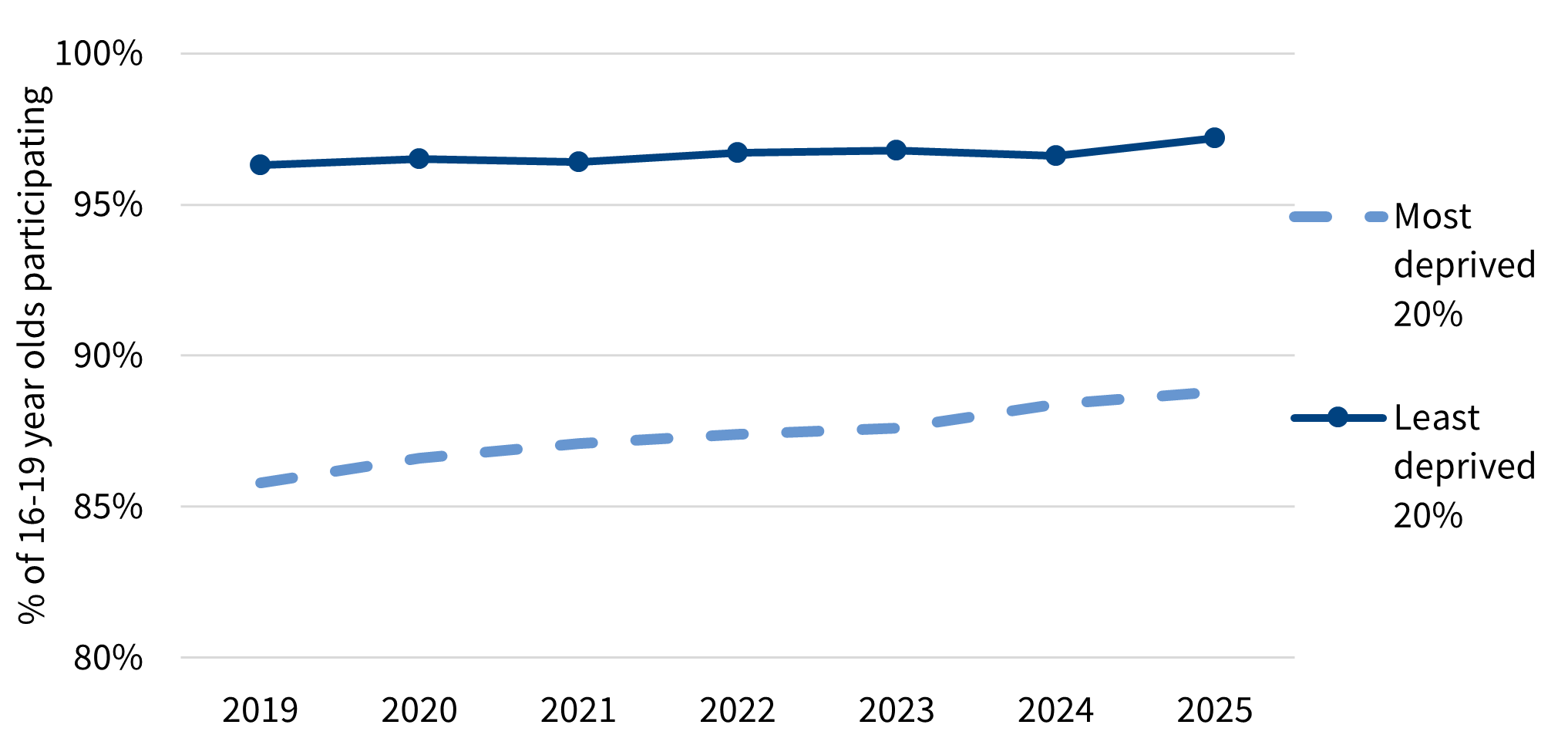
Source: Skills Development Scotland
Although the APM is drawn from an underlying dataset that supports a shared 16+ Participation Portal covering young people up to age 24, it does not currently report outcomes beyond age 19. As a result, it offers limited visibility of transitions into early adulthood, where participation is known to decline. As of January-March 2026, around 5% of 16-17-year-olds in the UK were considered NEET, compared to 11% of 18-20-year-olds and over 17% of adults aged 21-24. NEET figures for the age band 16-19 are not publicly available. Therefore, producing a 16–24 participation measure in Scotland would help provide a fuller, more comparable picture of post-16 trajectories and support better understanding of disengagement as young people move into adulthood.
The absence of a measure beyond age 19 creates a risk that health-related economic inactivity and longer-term disengagement are not fully captured and may therefore remain hidden, even where headline participation rates appear strong. Taken together, this underlines a key message of the Milburn Review: that improving early identification and system integration is essential to prevent young people falling through the gaps.
Employment (and employability) in Scotland
The review highlighted a range of problems across the systems that are designed to support young people who are not participating in education, training, or employment. Employability, skills and education policy, and employers themselves are all important parts of this system.
Fragmented geographies, uncoordinated policy areas, and short-term funding cycles were all brought up as issues which hamper efforts to improve young people’s situations in England, and we find that Scotland also faces these issues, although not to the same degree.
Employability programmes, in particular, are one of the main ways that governments can influence employment prospects and opportunities, especially towards targeted groups. It’s important to note that employability is not employment: employability programmes work with individuals to develop the skills and systems around them that they need to move into work. In Scotland, employability is partially devolved and is delivered at the local authority level through a funding scheme and organisational structure called No One Left Behind (NOLB).
The partial devolution means that there are competing employability structures at a local level in Scotland. Notably, DWP delivers employability services through Jobcentres, which may or may not align with NOLB delivery in local areas. The adult skills sector also adds to this complicated landscape, with 2023’s Withers Review finding that Skills Development Scotland and the Scottish Funding council have “at best… overlapping responsibilities, at worst, individual parts of the system work against each other.”
While there have been issues with the way NOLB has been implemented and inconsistencies with delivery across local authorities, NOLB is, in general, a good example of joined-up policy. The structure relies upon key workers bringing individuals closer to the labour market, which often involves cross-departmental collaboration. Key worker support can go beyond traditional labour market preparation, like CV preparation or interview practice, and into other barriers out-of-work people face such as transport, housing, and health. However, in early conversations with people delivering employability in Scotland,[1] we have found that there are nevertheless funding and structural issues that mirror those faced in England.
Inconsistent and short-term funding cycles are far and away the biggest concern brought up in conversations across the employability spectrum and are brought up repeatedly in any discussion on preventing ill health in the long run. Milburn put it well:
“Local partners across the country described short-term funding to the review as kryptonite for local systems. It prevents long-term planning. It destroys trusted relationships. Prevention has been cut at every level: early years, public health, youth services, further education. What has grown is crisis spending: late intervention, hospital care, income replacement. The system spends more to achieve less, often paying for the consequences of problems it chose not to prevent.”
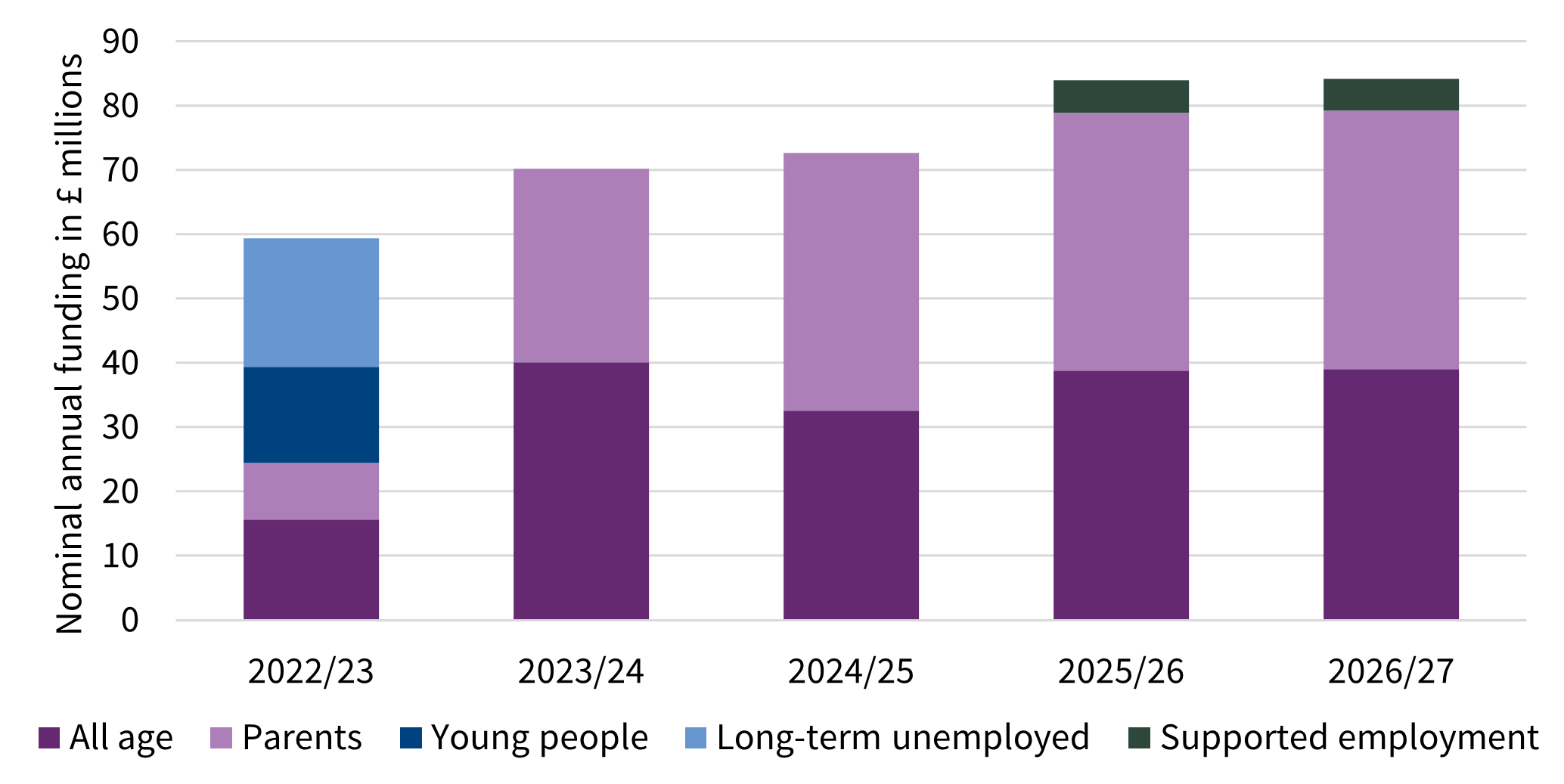
In our ongoing conversations with employability services, we have also heard concerns about ring-fenced employability funding being subject to short-term policy whims. In the wake of the pandemic, the Scottish Government ring-fenced NOLB funds for youth employment, through the Young Person’s Guarantee. This funding stream ended in 2023, and ring-fenced funds are now largely focused on parental employment support.
Arguably, all-age support, which allows local areas to deliver programmes that best fit their local needs, has largely absorbed this funding for young people, meaning that local authorities are still able to deliver services aimed at preparing young people for the labour market as they see fit. However, the Scottish Government now allocates more funding to parental support (£40.2m in 2026/27) compared to all-age support (£39m in 2026/27). Only £5 million is allocated to supported employment, which is aimed at disabled people or people with long-term health conditions (Figure 2).
This brings up a question about whether this money is being prioritised correctly in general, not just for youth services. In 2024/25, 43% of all NOLB participants were aged 15 to 24, 34% of all participants disclosed a disability, and 37% were parents (some of whom were also young adults or disclosed a disability).
Figure 2: Scottish Government employability funding allocations by priority group
Source: Employability in Scotland
Employability and skills alone cannot solve the long-term issues with the labour market, however. Milburn points out that traditional youth employment opportunities have declined, and there are fewer entry level jobs. Young people are more likely to be employed in retail and hospitality work, both of which have faced considerable pressure in recent years. In Scotland, accessing these jobs faces further complications, with transport and childcare rarely aligning to working hours in these industries.
Employers also play a substantial role in training and providing work for young people, and as Milburn points out:
“For more than two decades, successive governments have responded to youth disengagement through supply-side interventions. Policy has prioritised preparing young people for the labour market: improving their skills, activating their job search, reforming their benefits. […] The assumption has been that if supply improves, demand will absorb it. That assumption no longer holds.”
We have seen the same trend in Scotland: a long list of active policies targeting labour supply, and a difficulty understanding how to address labour market demand.
One mechanism is through apprenticeships, which form part of the skills and employment landscape in Scotland. The Milburn Review highlights apprenticeships as an area of concern, given their role as a key alternative pathway for young people at risk of entering NEET status, but as the Withers review discussed, the apprenticeship pathway is fractured between multiple organisations. The Scottish Government provides apprenticeship funding to three organisations: the Scottish Funding Council, Skills Development Scotland, and the Student Awards Agency, and there are currently three different types of apprenticeships: Modern Apprenticeships, which are a long-standing programme; Foundation Apprenticeships, introduced in 2016 and aimed at providing work-based learning opportunities for senior-phase secondary school pupils; and Graduate Apprenticeships, introduced in 2017 and structured around a post-secondary degree programme.
In recent years, starts on the Modern Apprenticeship route have followed a similar trend to apprenticeships in England. Starts among 16–24-year-olds have declined consistently over time, falling from a peak of 20,500 in 2015/16 to under 14,000 in 2025/26 (Figure 3).
This is something the SNP pledged to address in their manifesto for the 2026 parliamentary election; they promised to increase the number of apprenticeships to 150,000 over the next five years, 8,000 of which will be graduate apprenticeships. It is not clear how this will be structured over the coming years.
For comparison, over the previous parliamentary session between 2021/22 and 2025/26, Skills Development Scotland reported 126,569 Modern Apprenticeship starts. Between 2018/19 and 2022/23, the most recent five years for which we have data, there were 5,555 Graduate Apprenticeship starts.
Figure 3: Modern apprenticeship starts
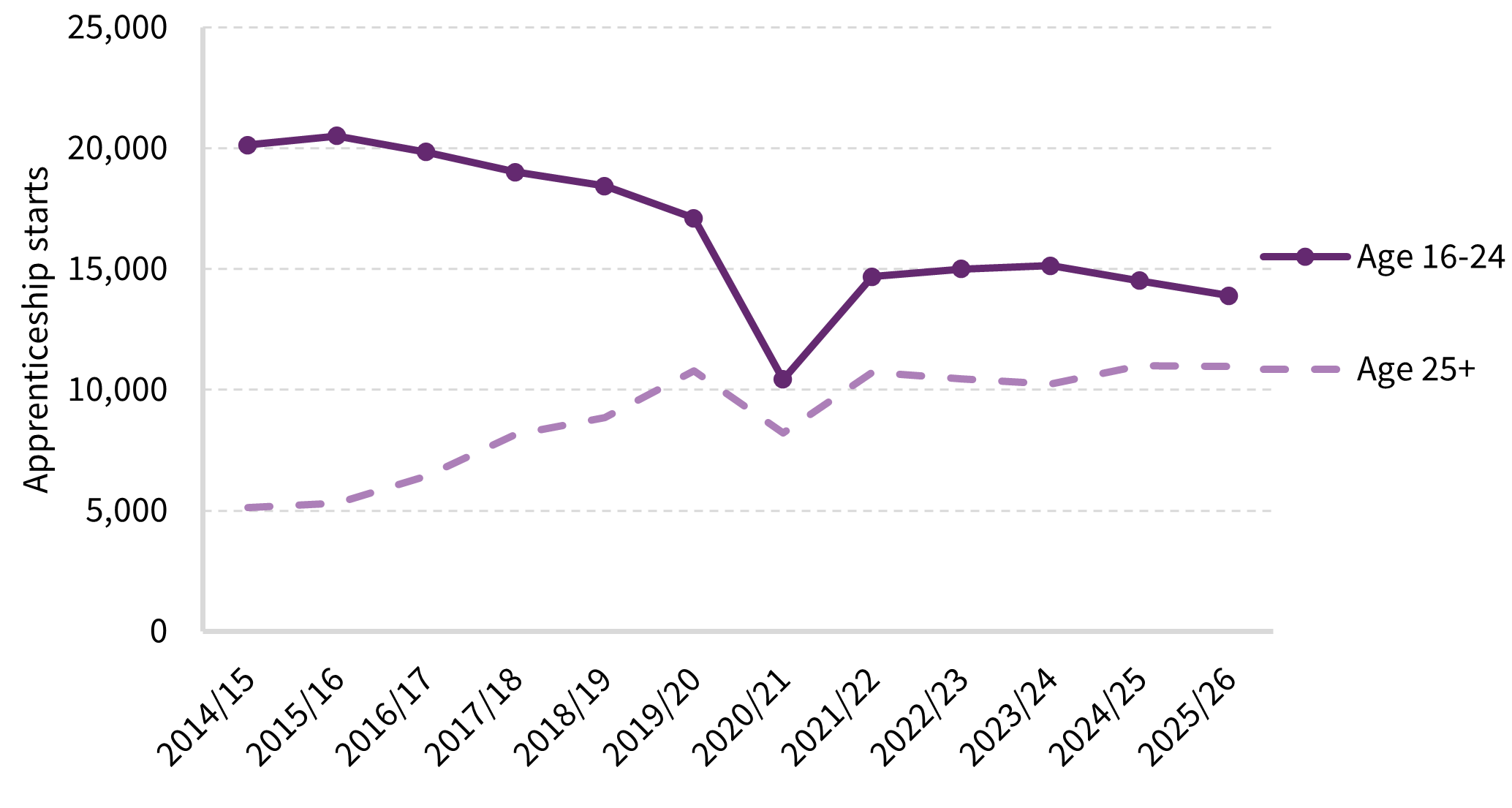
Note: The reduction in Modern Apprenticeship starts in 2019/20 and 2020/21 reflects the impact of Covid-19.
Source: Skills Development Scotland
[1] This research is part of our Strengthening Policy Implementation workstream. The full results of this study are due for publication in winter 2025/26.
Preventative systems
Although the report makes for tough reading due to the scale of the problem the UK faces, it is encouraging to see the factors affecting young peoples’ participation laid out by Milburn plainly and comprehensively.
The report has a big focus on systems. The education system, the healthcare system and the benefits system all have a role to play in young people accessing today’s labour market. But what Milburn picks up on is that it’s not just about points of failure in each of these systems – it’s about how these systems connect, how they share data, and how they enable a coherent journey for young people.
The other key point that Milburn raises is that prevention has been defunded and deprioritised in England: intervention typically occurs at points of crisis, which leads to treating symptoms rather than causes. The interim report highlights that we know from a young age who is at risk of becoming NEET, but that there is a lack of resource for institutions to take truly preventative action.
Both of these points align strongly with SHERU’s research in Scotland. Initial findings from our Strengthening Policy Implementation workstream have shown that practitioners in Scotland face fragmented systems every day, and that these are actively standing in the way of supporting individuals. Data sharing is too minimal and underdeveloped to support joined up working across different departments and organisations. We have also heard that the level of resource required to tackle current crises means prevention is very difficult to do well. Short-term funding is exacerbating this problem, as prevention tends to take more time to do correctly.
Something Milburn does well in this review is not placing blame on any one actor or institution. What the report rightly points out is that everyone is working to different success criteria, with separate funding streams and accountability frameworks. No one institution can be responsible for the entire journey, but there must be a middle ground where efforts are more cohesive.
Crucially, the interim report highlights that inaction is in itself a choice:
“We have a deeply entrenched problem that is getting worse and a system that has been trying but failing to deal with it. Fundamental and far-reaching reform is needed. The country has reached a point where inaction or iterative tinkering is itself a decision, and a costly one.”
We believe much of the system-focused critique here applies not just to young people’s participation in the labour market, but to the challenge of shifting to a preventative approach more widely and therefore to reducing health inequalities across the board. We look forward to the final Young People and Work report, where Milburn aims to outline learning from international contexts and potential solutions.