


Employability in Scotland: what do we know, and what remains unclear?
A PDF version of this article can be read here.
Employment is a key determinant of health inequality, and a central focus for health-related policy across both Scotland and the UK.
In recent years, a number of reports and government policies which explore ways to increase employment, including among disabled people or people with long-term health conditions, have been released at both the UK level and in Scotland.
Notable recent UK-based publications which discuss this issue include the UK Government’s Get Britain Working White Paper in 2024. The paper identified two groups of people who could have the most significant impact on this number: young adults and people in poor health.
The UK Government’s Pathways to Work Green Paper published in March 2025 also had a clear focus on disabled people and people with health conditions and promised an additional £1 billion in tailored employability support for people with health conditions or disabilities across the UK. The current UK Government also commissioned the Keep Britain Working review which reported in November 2025 and highlighted the shared responsibility of individuals, employers, and government in improving employment outcomes for people who are out of work due to health reasons, proposing “[…] a fundamental shift from a model where health at work is largely left to the individual and the NHS, to one where it becomes a shared responsibility between employers, employees and health services.”
Employment policy is partly devolved, and Scotland also has long stated aims on improving employment among disabled people, which includes people with limiting long-term health conditions. For disabled parents or parents with long-term health conditions, in particular, employment is a key part of the Scottish Government’s strategy to reduce child poverty, which is in itself the “top priority” of the current government.
Scotland also has a goal to reduce the disability employment gap by half between 2016 and 2038. In 2016, the employment rate for non-disabled people was 37.5 percentage points higher than that for disabled people. The goal is to increase employment among disabled people by 18.7 percentage points by 2038.
The Scottish Government also considers disabled people and people with long-term health conditions to be a top priority group according to their employability strategy, called No One Left Behind (NOLB).
This paper focuses on the NOLB strategy as a key part of the Scottish Government’s active employment policy. As well as supporting people who already have health challenges into work, NOLB also has a role in supporting household income, and preventing health conditions emerging as a result of inadequate living standards.
In the coming months, SHERU has a range of work planned which will explore employability policy in Scotland including looking in more detail at the available data, and on the implementation of the policy. Anticipating this, we thought it would be helpful to provide a brief overview on the role of No One Left Behind, its structure, and an introduction to evaluating its efficacy, leading into our forthcoming work.
What role do employability programmes play?
Employability programmes are one of the main ways in which a government can directly influence employment, especially towards a targeted group, like people with long-term health conditions or those at risk of poverty.
“Employability” is not “employment” – employability programmes generally work with an individual to develop the skills and systems around them that they need to move into work. This can be through direct job or apprenticeship placements, education and training, support in things like making a CV or interviewing, finding volunteering opportunities, connecting people with health services, or supporting people in finding childcare or transport options, among other things.
Both the Scottish and UK Governments have a range of levers available to address employment. One method is through fiscal and monetary levers. Things such as changes in infrastructure spending, changes in taxation, changes in benefit policy, and changes in interest rates (set by the Bank of England) can influence businesses to change their spending patterns and increase hiring. Regulatory levers, industrial policies, and changes in international trade also influence business’ hiring decision. These policies influence the “labour demand,” which is the number of people that businesses want to hire.
There are also a variety of policies which impact prospective workers – the “labour supply,” if you will – that are both direct and indirect. For instance, changes in childcare availability or transport are not themselves employment policies but can indirectly influence how easily people are able to access work. Employability policy, such as NOLB, is an example of a policy that addresses the labour supply.
Funding for employability: opaque and difficult to follow
Since 2019, the Scottish Government has consolidated the majority of employability funding and created a strategic framework for delivering employability at a local authority level. Prior to 2019, Scotland offered a range of funding for employability services, including Fair Start Scotland, that was delivered through different budgetary line items at both a national and regional level. Organisations delivering employability services may also receive funding from other streams within Scottish Government, from the UK Government, or from other sources.
No One Left Behind (NOLB) is the term used to describe the Scottish Government’s approach to employability. This can be confusing, because it simultaneously refers to the strategic framework for service delivery, an umbrella term for multiple funding streams, and a specific budgetary line item for employability support.
NOLB funding is complex because of the way that the funding stream moves from the Scottish Government to local authorities, and then on to funded organisations. This process makes it difficult to follow the money through to how it is spent. Even though NOLB is delivered at local level, we usually see employability funding as a line in the Scottish Government’s budget, separated from the Local Government Core Settlement, also known as the General Revenue Grant which is the main grant that local authorities receive from Scottish Government to provide local services. Often multiple documents need to be referred to in order to clarify how much money is going to local government and the amounts aren’t always easy to follow.
For example:
- In the 2025/26 Scottish Budget, the actual Budget Document has £104.5m labelled as “Employability”. Looking at the detailed level 4 tables an amount of £98.1m is listed as the budget item “Employability and Workforce Skills” under the Deputy First Minister, Economy, and Gaelic (DFMEG) section, specifically noting that “[t]his budget represents a continuation of investment in all-age devolved employability services delivered through our No One Left Behind approach.”
- Another document released at budget time, the Local Government Finance Circular, then refers us to Table 4.15 which is published alongside the budget which provides “further revenue and capital funding streams outwith the local government finance settlement for particular policy initiatives which deliver on shared priorities and support local government services”. In other words, these are ring-fenced funds that sit outwith the General Revenue Grant. Here we find a figure of £81.4m labelled “NOLB, including the Parental Employability Programme”. This includes some, but not all, of the figure in the Scottish Budget “Employability and Workforce Skills” spending line.
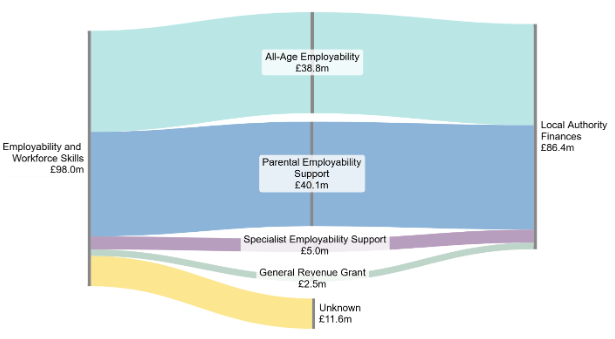
- Separately, the Employability in Scotland website provides detail on how much each local authority receives within the “Employability and Workforce Skills” budget item. In 2025/26, the total figure in this document is £86.4m. Three ring fenced funds fell under this budget: No One Left Behind (which will sometimes be referred to as an “all-age employability fund,” or something to that effect), the Parental Employability Support fund and a separate line for Specialist Employability Support. There is also some funding that is earmarked as General Revenue Grant (the non-ring-fenced grant to Local Government).
Having different amounts in different places, without an explanation as to the reasons why, inevitably confuses most people looking at these figures. There are genuine reasons there might be variation through the year, for example, to reflect changes in resources from decisions made by the UK Government that lead to changes in money coming to Scotland from the Barnett Formula. Some documents may be updated through the year; others may not be. However, it is incredibly difficult to keep track of all these changes, and the reasons why changes are made.
For example, is not clear from our attempts to track spend what has happened to the £11.6 million that is in the Level 4 budget breakdown in 2025/26 but does not appear in the breakdown on the Employability in Scotland website (Figure 1). Some of the Scottish Government assigned budget probably goes into Scottish Government operating costs, but there is not any further detail on the proportion of each line item that feeds into this.
Figure 1: Our understanding of funding allocations from the Employability and Workforce Skills budget item to Local Authority finances (2025/26)
Source: Scottish Budget, Employability in Scotland
The Scottish Government transfers these funds to individual local authorities annually using a needs-based formula. Again, the process is a little unclear. The final amounts are decided via a negotiation between COSLA and Scottish Government ministers, using recommendations from the Settlement and Distribution Group, which is made up of Scottish Government officials, COSLA officers and a selection of local authority officials. It is not clear to us from publicly available information what indicators are used to determine how employability funding is allocated for No One Left Behind and more transparency would be welcome here.
At a local authority level, the way that these funds are dispersed can also be opaque, and local authorities often have different reporting practices, adding to the difficulty in understanding how money moves through the system. Some councils, such as Argyll and Bute, have clear, publicly-available descriptions of how their funding is allocated, whilst many others do not. We do know that at every step, money that the Scottish Government has specified for a specific purpose, like parental support, remains ring fenced, and organisations receiving these funds are responsible for demonstrating how they are meeting that function. It is difficult to track, however, which organisations each local authority funds.
In general, a board called a Local Employability Partnership (LEP) determines which demographic groups to focus on and which organisations to fund. The LEP is made up of a variety of people, which often includes representatives from DWP, local authority employability departments, Skills Development Scotland, local businesses, schools, among other places. The LEP is also responsible for finding additional funding sources for employability, which may come from third sector grants, other Scottish Government grants, other funds available within the local authority, or other UK funding pots.
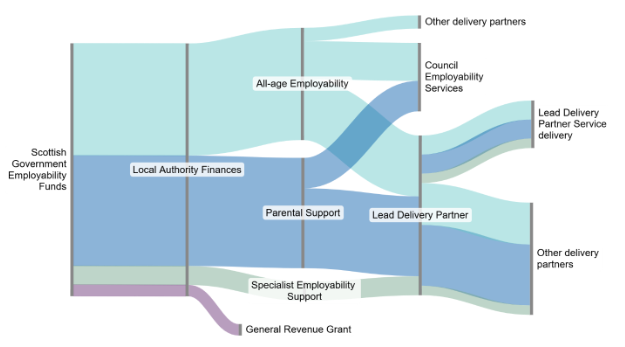
Local authorities then distribute these funds to different employability service providers (also called “delivery partners”). In some areas, one delivery partner (the “lead delivery partner”) can act on behalf of a group of delivery partners (sometimes called a “consortium”). The lead delivery partner can apply for, receive, and distribute funding to members of the consortium accordingly. Some areas do not have this arrangement, and some may provide employability services exclusively or predominantly through the council.
Figure 2 provides an example of the flow of money from the Employability and Workforce Skills budget from the Scottish Government to local authorities and to delivery partners, based on a snapshot provided by one local authority. This is for illustrative purposes and shows how complex the flows of money can be.
Figure 2: Example of flow of funding from Scottish Government employability pots to a Local Authority and then to organisations which deliver employability services
Note: The sizes of relative flows are not to scale. This represents an illustrative version of funding flows based on one local authority and does not necessarily reflect how all local authority funding works in practice.
The local delivery model for determining who gets support
The system of local delivery allows local areas to determine which groups and areas to prioritise for employability support, although as already discussed the Scottish Government does have earmarked funds for specific priority groups. Local divergence means that local authorities often have very different outcomes across people using NOLB-funded programmes.
In general, employability programmes operate by pairing an individual to a “key worker.” The key worker supports their client by discussing their needs and employment goals, and then by preparing a plan to help that person reach those goals. Key workers are employed by NOLB-funded programmes and may refer people to other NOLB-funded programmes within their local authority: for instance, a person may approach one employability service who may refer them to a more specialised programme.
The support that people receive can include a range of activities, such as training, education, mentoring, and volunteering and job placements, among other activities. For instance, the Shetland Islands funds driving lessons from their NOLB budget. This may not automatically feel necessarily within the remit of employability programmes but is a clear area where a local authority has identified a barrier to employment for some people and uses funds to address it. With this in mind, achieving employment is not the only positive outcome that people can experience through employability programmes.
While disabled people and people with long-term health conditions benefit from the breadth of services that employability programmes offer, the localised nature of No One Left Behind means that in some cases, people with specific support needs may not be able to find programmes targeted to them in their area. This may be because certain programmes just do not have a presence in a local area, or because local authorities may choose to prioritise NOLB funding differently.
How do we evaluate whether employability programmes are working?
Currently, it is difficult to evaluate the performance of employability programmes at a local level, and we do not know how successful local authorities are at supporting people who are out of work because of their health into work, even though this is a central tenet of NOLB.
All local authorities are required to report the same data (called the Shared Measurement Framework) to the Scottish Government but may have different data collection methods and priorities. This means that outcomes across local authorities are not necessarily comparable. It is worth noting that NOLB statistics are currently considered Official Statistics in Development, meaning that they are being tested for trustworthiness, quality, and value in line with the UK’s Code of Practice for Statistics. Comparability between geographical areas is a desirable aspect of the “quality” dimension for Official Statistics, but not necessarily a crucial element. There are also different degrees of comparability, and this data may be sufficiently comparable for the Scottish Government’s needs, while being inadequate for other people trying to understand how well the system works by comparing local authorities to each other.
It is also important to consider what outcomes are considered when evaluating the success of employability programmes. In addition to employment, other outcomes like training and volunteering are often reported. These outcomes can be an important step in moving people closer to the labour market, and this can be subjective or very individual in a way that is unlikely to be reflected in overall statistics. However, paid employment is the “ultimate” outcome in the sense that it is the main purpose of employability services and the outcome that plays the largest role in reducing health inequalities. Understanding all destinations is important for judging whether employability services are working, but we would like to see more clarity in how these statistics are reported.
A recent article from colleagues at the Fraser of Allander Institute, Chirsty McFadyen and David Jack, looked into how effective Scotland’s employability programmes are for supporting people with learning disabilities. Importantly, they noted that there is likely a “postcode lottery” for services, with some local authorities having much better service provisions for disabled people or people with long-term health conditions. Comparable data between local authorities would allow us to compare outcomes across these different levels of service provision and also allow local authorities to learn more from approaches employed elsewhere. They also noted that NOLB summary statistics are insufficient for analysing how well NOLB works in assessing the wider effects of its services, and that causal and qualitative data is largely missing.
There are two key reasons why outcomes cannot be robustly compared between local authorities.
For one, local authorities have different funding strategies and internal priorities. This is the nature of NOLB’s design, and not necessarily a problem. For instance, one local authority may choose to target funding to people who are closer to the labour market, meaning that less work needs to be done to help them get into work, while another might target people further from the labour market. The first local authority will likely have more people entering employment from an NOLB-funded programme compared to the second, but this does not mean that the first is more successful. The missing piece in evaluating the performance of local authorities, therefore, is the strategy and reasoning behind their funding decisions. While this is provided to Scottish Government, such rationales are often not publicly available (or, if they are, are difficult to find).
Another issue may come down to differences in data collection, which can result in some local authorities having higher rates of missing data compared to others. For instance, between April 2019 and June 2025, 11% of all NOLB participants in Scotland had an unknown disability status, but this ranged from less than 5% of participants in some local authorities to more than 30% of participants in others. This missing information makes it difficult to accurately see whether measures of success for specific groups differ across local authorities.
One reason for these differences seems to be that some local authorities require the data collected under the Shared Measurement Framework to be completely filled out once an individual enters into a NOLB-funded programme. Others do not have this requirement but rather ask that it be filled out at some point during the user’s journey. Local authorities report on people using the service quarterly, and some users may have dropped out before responding to disability questions, while others may not have been asked about disability status at that point in their journey.
There are pros and cons to both methods of data collection. On one hand, more complete records mean that a local authority is in a better position to assess their progress. At the same time, the Shared Measurement Framework covers more than 100 data points and asking all these questions the first time a person meets a key worker could be intimidating and overwhelming. For their part, the Scottish Government ask for reporting to be completed at some point in the user journey, not necessarily during the first meeting, and acknowledges that there will necessarily be some volume of missing data in each local authority’s quarterly reports.
Next steps
In the coming months, we will be exploring evidence on how local authorities make decisions on who gets support, and the evidence they gather on impact.
We already know there are notable issues with the data that LEPs use to make decisions. LEPs use a range of data sources, but labour market surveys, administered by the Office for National Statistics (ONS), are the primary source of regional employment statistics. Unfortunately, in recent years, falling survey responses have rendered much of this data effectively useless at the local level. This could mean that the way funding is allocated within local authorities is, through no fault of their own, based on a flawed understanding of their local labour market. We understand that some of the funding from Scottish Government to local authorities is also determined based on local-level data collected by the ONS, and inaccuracies in data could also result in resources being misallocated.
Because of this concern, we are developing a model to count the number of people within local authorities that are not in work using alternative administrative data sources, with a goal to provide areas with a sense of how many people are potential users of their employability services. This model builds upon a model we previously developed looking at labour market data for Scotland as a whole.
Furthermore, there is a lot more to say about the policy more generally, including how it has been implemented across Scotland. As part of our Strengthening Policy Implementation work strand, we are conducting qualitative research into NOLB implementation within local authorities and are working on a more in-depth piece analysing the employability landscape using a policy tracing methodology.
No One Left Behind is also an evolving policy area.
In particular, we may see some re-examination of the model from the Scottish Government. The 2025-26 Programme for Government, which sets out the legislative programme for Scottish Parliament leading into the next election, promised to review “… the delivery of employability programmes to maximise their effectiveness and bring forward proposals ahead of the Budget 26-27, including consideration of a national model.” There is still uncertainty over what this “consideration of a national model” refers to in practice, and at the time of writing, no updates have been published.
There are other emerging aspects of NOLB that we are also keeping an eye on. For instance, No One Left Behind’s strategic plan from 2024-2027 identified an emerging need to work with employers to improve labour market outcomes. The UK Government echoed this need in the Keep Britain Working final report, which recommended incentivising employers to recruit and retain disabled people or people with long-term health conditions.
The upcoming Scottish elections will provide a chance for all Scotland’s political parties to put forward their views on the future of employability services in Scotland, and we’ll be keeping a close eye on this as manifestos are released in the next few months.